A blog focused on nature, science, environmental topics, and happenings at the Pocono Environmental Education Center (PEEC).
Beginner’s Mind in the Forest
- Details
- Written by PEEC - Janine
- Category: PEEC Blog
Naif in the Forest by Darrell Berger
Wing Tips to Hiking Boots: Musings of a New, Full-Time Poconos Resident
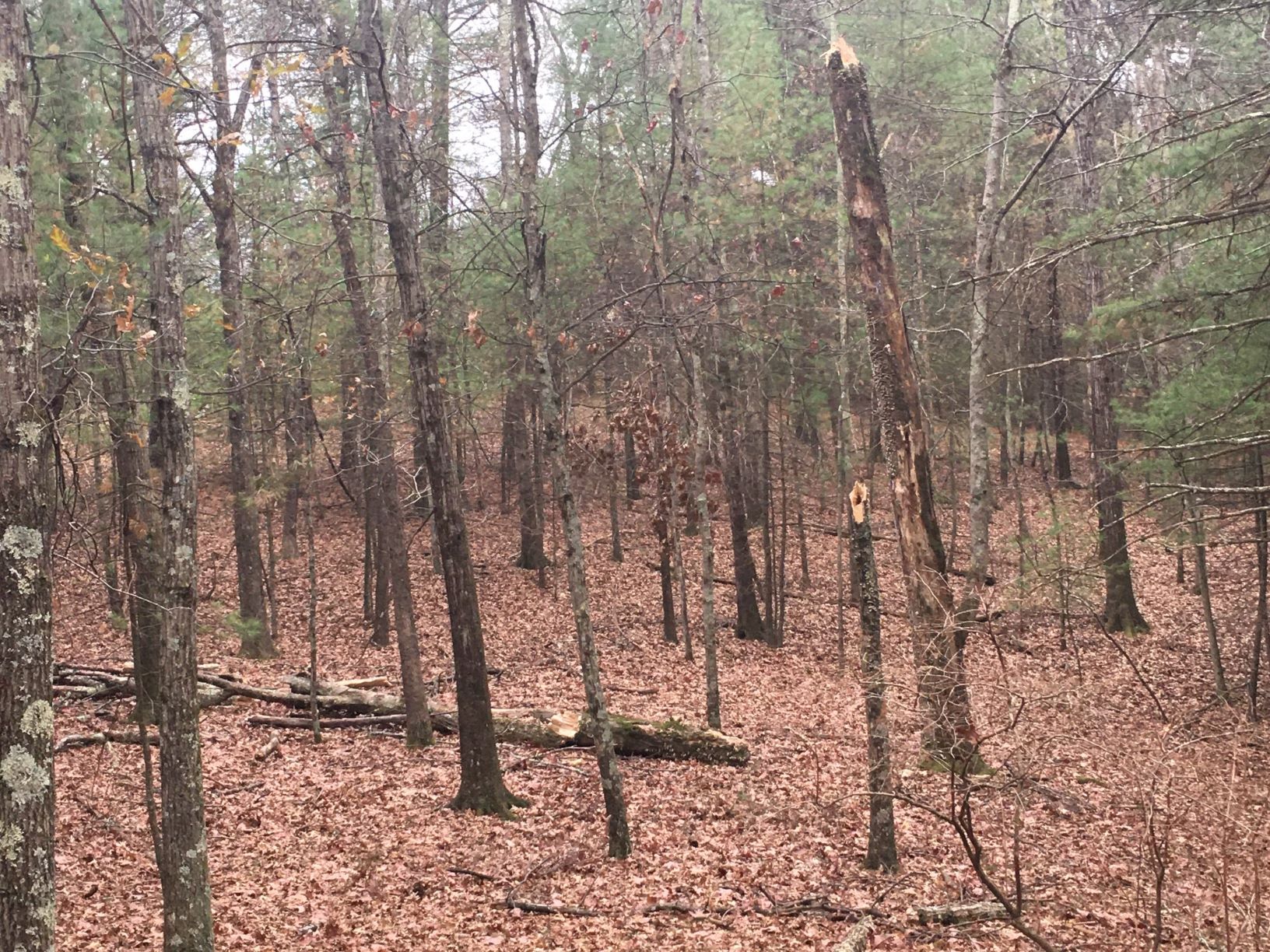
I walk through the same part of the forest almost every day. I noticed that the higher portion of this tree had fallen. I saw the fresh, clean area where it had broken, and the part that was still upright. There has been little new deadfall since the big storm two years ago.
Deadfall had been a new word to me when I started writing this blog. I didn’t know the forest. I would not have recognized the woodpecker’s fresh drilling upon the log, or appreciated the new environment for fungus, insects and small mammals it will provide. I examined the fallen tree. Why did it fall in this direction? Was there structural weakness, storm damage?
To my surprise, I may no longer be a naïf in the forest, that is, an innocent or ignoramus, depending on the kindness of one’s judgment. After more than a year of observing the forest my perception has sharpened. I no longer see the forest with completely new eyes. The seasons are more apparent to me, the interdependent lives of forest dwellers more meaningful.
I am far from an expert. Perhaps I have gone from ignorance to what Zen Buddhism calls “beginner’s mind.” Suzuki Roshi said, “In the beginner’s mind there are many possibilities, but in the expert’s there are few.” The naïf doesn’t see the path. The beginner sees it and has just begun the journey. The expert knows the path so well the beauty of the journey is diminished. Beginner’s mind helps sharpen one’s perception, challenges prejudices and obviates the tendency to quit in the face of new challenges. I’ll keep the name of the bog, however, as my capacity to get lost even in familiar territory, literally or figuratively, is vast.
The forest provides endless variety to those who have eyes to see. Beginner’s mind is useful whenever we find ourselves incapacitated by the limits of our experience or expectations. The path through the forest helps me awaken to possibilities elsewhere in life. A newly fallen tree is notable, and any moment teachable.
A Modernist Woodpecker
- Details
- Written by PEEC - Janine
- Category: PEEC Blog
A Naif in the Forest by Darrell Berger
Wing Tips to Hiking Boots: Musings of a New, Full-Time Poconos Resident
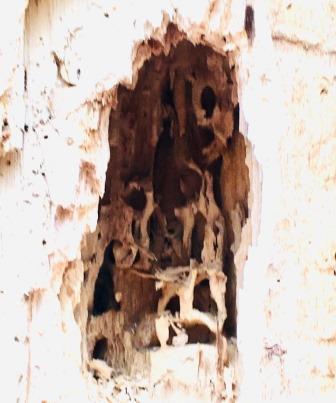
A pair of piliated woodpeckers visited our bird feeders for several days on the cusp between fall and winter, favoring the suet. Soon their work appeared on nearby stumps and deadfall. Most prominent among them was this shadow box. It is two feet above ground, approximately ten inches by five. The photo is overexposed to reveal the dark interior.
“This reminds of something Gaudi might have designed,” I said to Kathleen.
“Perhaps cave dwellings in the side of a mountain, or a grotto,” she added.
Antoni Gaudi, the great Catalan architect of the first quarter of the twentieth century, was a serious student of nature. The caves of Montserrat, Collbato and Mallorca were major influences. His style is unique and instantly recognizable, even as it is reflected in the work of a woodpecker. He began as a typical if gifted modern architect. His passion for natural forms that flowed and defied conventions created a style impossible to imitate. His structures are unmistakable.
Most woodpecker holes are hollowed. There was something about this tree that caused parts of its interior to be harder to penetrate than others. The rapid fire of woodpecker beak worked around the harder places, a natural excavation seeking the more yielding sections of a natural media. The result is this flowing pattern. The wood seems to be dripping as it forms openings and lattices, as does the stonework of Gaudi’s church of Sangrada Familia in Barcelona. The caves that inspired Gaudi also flowed and dripped.
What connects Gaudi’s church, the woodpecker’s stump and the caves? The human’s brain, the bird’s beak and the natural elements at work over eons created them. This is like saying that a chisel created Michelangelo’s David. Some greater common element was working through the chisel, the hand of the artist, his love for the model and his devotion to its expression.
This creative force has many names and no name. The caves, the church and the hole in the stump are so similar the same artist seems to have created all three.
River Stories from Swarthmore College
- Details
- Written by PEEC - Janine
- Category: PEEC Blog
In August 2019, ten Swarthmore students and their professor, along with PEEC staff, embarked on a 7-day sojourn along the Upper and Middle Scenic Delaware River. Their overnight camping trip totaled nearly 70 miles of beautiful rapids, mountains, and wildlife. After returning to school and some hard work, they have shared their stories with us. Follow our adventure through their eyes in this wonderful story map!

The Rodent of Thor - Addendum
- Details
- Written by PEEC - Janine
- Category: PEEC Blog
A Naif in the Forest by Darrell Berger
Wing Tips to Hiking Boots: Musings of a New, Full-Time Poconos Resident
It has been brought to my attention that though I had never seen a gravestone with a squirrel motif, many exist, like this wonderful creation at Clover Hill Cemetery, Harrodsburg, Indiana. I am happy that there are some people out there who appreciate the little fellows’ contribution to the cycle of life and to the mighty oak. My thanks to my research assistant, Jeff Rosalsky.

The Rodent of Thor
- Details
- Written by PEEC - Janine
- Category: PEEC Blog
A Naif in the Forest by Darrell Berger
Wing Tips to Hiking Boots: Musings of a New, Full-Time Poconos Resident
Receiving an oak leaf cluster is a military honor. In heraldry, the oak leaf indicates independence, the acorn fertility. Gravestones have used oak leaves and acorns as decorations, indicating the cycle of life. In mythology the oak is the tree of both Thor and Zeus. In 2004 the US Congress declared it the national tree.
When I wandered through the forest recently, and saw a lot more acorns than last year, I wasn’t just seeing nuts that squirrels, deer, jays and turkeys depend on. I was seeing the bounty from the tree of the gods, the tree of military and national honor.
Acorns are plentiful in alternating years. Oaks work very hard one year and rest the next. Humans once depended on the size of the acorn harvest because acorn flour was a staple. No wonder oaks were sacred. Native Americans particularly valued them. Many communities still have or remember “council oaks,” where important tribal meetings were held.
If the oak has long been of vital importance to everybody in the forest, the squirrel is vitally important to the oak. For an acorn to grow into a tree, it prefers to be in the earth sixty to ninety feet from the parent, away from shade, with a source of underground nourishment that is not consumed by the parent. Squirrels are the primary vehicles for transporting acorns.
Squirrels have a very good memory for where they have cached food, but it isn’t perfect. Some squirrels don’t survive to eat all they have stored. Only a miniscule percentage of acorns grow into oaks, yet enough to keep the forest replenished.
Thus the tree of Thor and Zeus and America needs squirrels. Yet nobody calls squirrels the rodent of Thor. Valiant soldiers are not decorated with brass and silver squirrels. Squirrels are not the official nut gatherer of the United States. I have yet to see a gravestone with a squirrel motif. We find once again that the work of the smallest is required for the mightiest to survive, yet goes unheralded.