A blog focused on nature, science, environmental topics, and happenings at the Pocono Environmental Education Center (PEEC).
Leaf Warrior
- Details
- Written by PEEC - Janine
- Category: PEEC Blog
A Naif in the Forest by Darrell Berger
Wing Tips to Hiking Boots: Musings of a New, Full-Time Poconos Resident
Winter’s snow has been replaced by the leaf blanket of early spring. In previous years, I raked leaves from our driveway and the few flowerbeds we determinedly carved from the mountain shale.
Now we have finished a major landscaping: a stone sidewalk, several additional flowerbeds, bushes, a raised bed for herbs and vegetables. We hope a tall mesh fence will keep the deer from the garden. Many more leaves must now be cleared. I shopped for my first leaf blower.
I chose a snazzy model, sleek and futuristic, Luke Skywalker’s leaf blower. Three speeds and a battery pack. No blue tooth. I could wield it with one hand, like a Viking his broadsword. All ground cover shall yield to my power!
First attempts brought mixed results. The modest pile I accumulated returned to chaos with an errant turn of my wrist. What blew the leaves together can also blow them even farther apart. Twenty minutes of labor wasted in an instant. “Doah.” My leaf blower self-image sagged from Jedi Warrior to Homer Simpson. An older generation would have noted my resemblance to W. C Fields, suddenly surprised at the damage wrought from his own ineptness.
I concluded one must approach this task like a border collie, defining and patrolling the boundary of the herd of leaves. I carefully nudged them closer together, finally directing them to what was now the edge of the forest, where they could be reunited with their kind.
This worked. The battery charge lasts about 45 minutes, as do I. A couple charges over a couple days and I was finished, needing only to fine tune the job by picking those last few leaves from crevices and bushes.
Mastering the power of the leaf blower was essential. I couldn’t just point it toward the leaves without a plan and expect to accomplish anything but make a bigger mess. I needed a little experience, considerable patience, and an end game. Power alone does not make a leaf warrior. Foolish power can destroy in an instant what wisely directed power needed time and forbearance to create.

Don't Eat the Wolfsbane
- Details
- Written by PEEC - Janine
- Category: PEEC Blog
A Naif in the Forest by Darrell Berger
Wing Tips to Hiking Boots: Musings of a New, Full-Time Poconos Resident
“The wolfsbane should be coming up soon,” my wife said.
“You planted wolfsbane? That is so cool!” I replied. I was fascinated by vampires, zombies and werewolves as a boy. Wolfsbane is well known to werewolf aficionados as a useful deterrent.
Then I discovered that wolfsbane, also called monkshood because the flower looks like one, is deadly poisonous and has been used for centuries to kill real wolves. Should we be growing it with Violet the Corgi sniffing about?
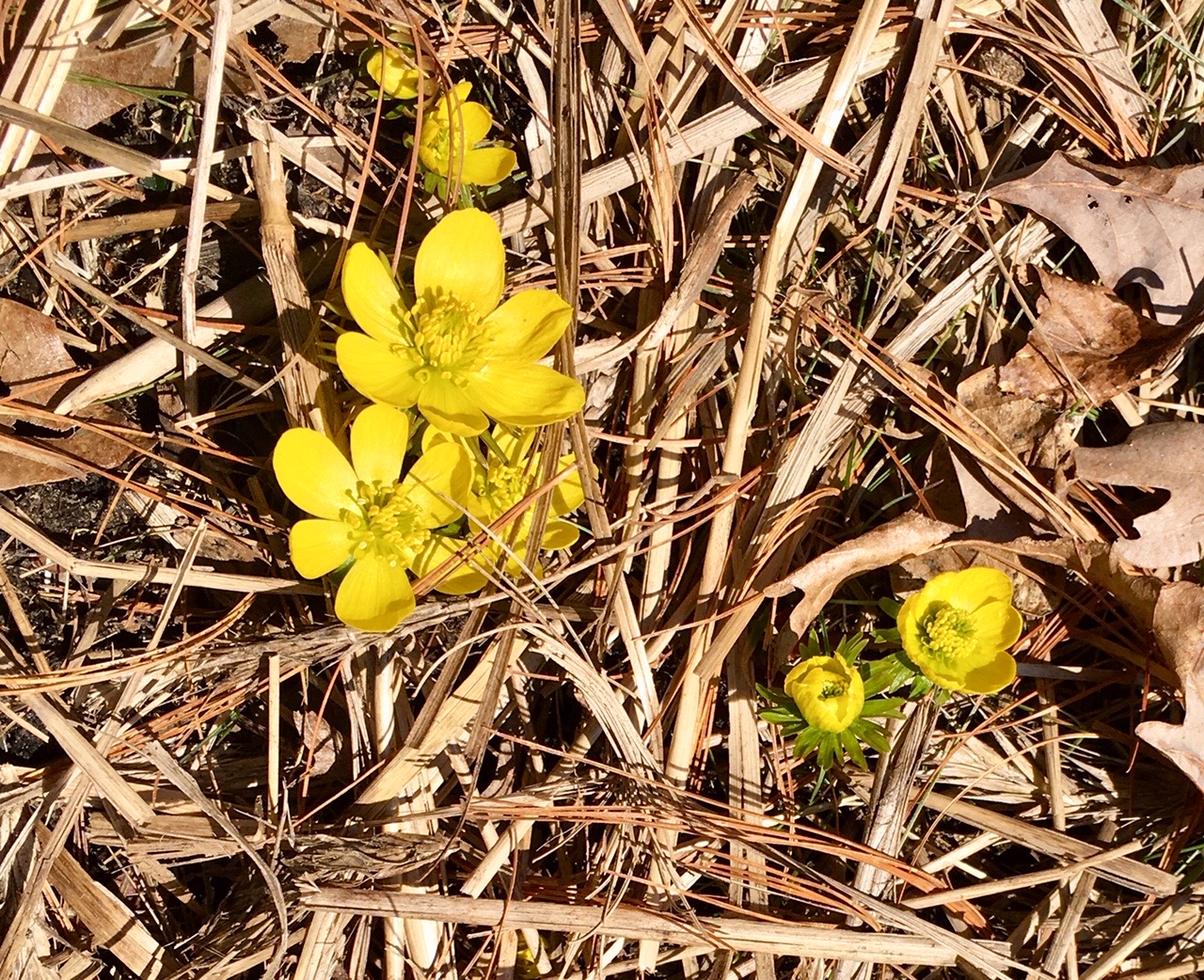
Kathleen thought it unlikely that her seed supplier was selling deadly poisonous plants. We found she had planted winter wolfsbane, or winter aconite, a relative to the real thing, but not harmful. Or was it?
Websites, from seed catalogues to academic journals, differed. Some say it is not harmful or don’t address the issue. Others say that the whole plant is toxic, especially the bulb.
At the advice of my veterinarian, I checked the ASPA website list of toxic plants. No winter’s wolfsbane, but no real wolfsbane, either. If they left out an obviously toxic plant, then perhaps the omission of the winter kind was not proof of its innocence.
I again perused the list of plants poisonous to dogs. Chamomile, chives, daffodils, lemon grass and onions were included, along with many other common plants, as well as several we encounter in the forest, like milkweed. The whole forest is toxic!
Apparently winter wolfsbane is poisonous, but not very, similar to daffodils. No case has ever been reported of a dog getting sick from it. It might be poisonous if you made winter wolvesbane tea and served it to someone every morning, not that I’m suggesting this. A dog digging or munching at it would be in little danger.
We are now free to enjoy the little flowers, which appear even before crocus. Since I have seen no werewolves in our part of the forest, the wolfsbane must be doing its job. Nor has Violet developed a bark that says, “Danger, werewolf approaching!” I wonder what that bark would be like?
A Tree of War and Peace
- Details
- Written by PEEC - Janine
- Category: PEEC Blog
A Naif in the Forest by Darrell Berger
Wing Tips to Hiking Boots: Musings of a New, Full-Time Poconos Resident
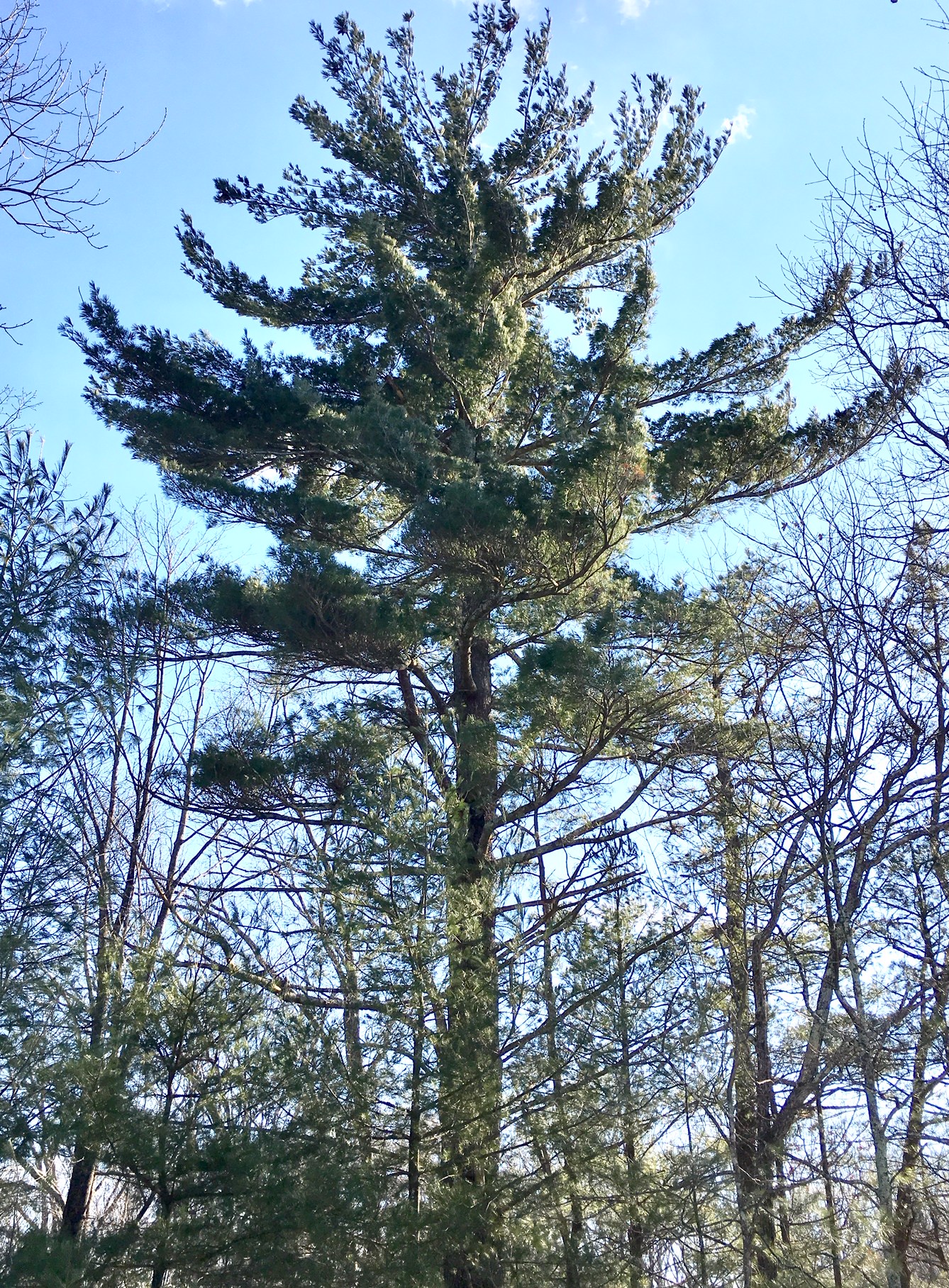
When countless trees were felled by last winter’s high winds, this tree was the one we watched. Our house would be significantly demolished if it toppled toward us. It did not. It seems to be not only the tallest, but also the strongest and most resilient tree in our part of the forest.
It is an eastern white pine, pinus strobus, the tallest tree in the eastern United States. Many are over 200 years old, some over 400. The Iroquois Confederacy called it “the tree of peace,” yet it helped spark a revolution.
Its long, strong trunk was highly coveted for the masts of sailing ships. This made them particularly attractive to the British Empire in the eighteenth century, for both commerce and war. Great Britain, however, had forested their own land to near bareness, and looked to their colonies.
A law was passed making it maddeningly difficult for colonists to harvest their own white pines, but allowed confiscation by the crown. This led to the Pine Tree Riot of 1772. The British sheriff of Hillsborough County, New Hampshire was awakened in the middle of the night by colonists angry about his arrest of a local logger. They beat him with switches and small logs, and ran him out of town. This discouraged the British from enforcing the law and inspired a similar event called The Boston Tea Party.
Long, strong logs are no longer in high demand for the conduct of commerce or war, having been replaced by oil, various metals and perhaps, in the near future, that diminishing but essential natural resource, water. Who knows what the next world power will find essential for their empire, or where they will find it.
Having lost their high strategic status, white pines are now allowed to grow tall over their neighbors, though they are still in demand for the strength and size of their wood. Perhaps, since they are now used extensively as Christmas trees and holiday wreathes, they can even reclaim their Iroquois status as a tree of peace.
Bearly Present
- Details
- Written by PEEC - Janine
- Category: PEEC Blog
A Naif in the Forest by Darrell Berger
Wing Tips to Hiking Boots: Musings of a New, Full-Time Poconos Resident
Was winter finally breaking? My wife said, “We should think about taking down the bird feeders this weekend.” The anxious interval between bear arousal and the final retreat of the snow was upon us. We don’t wish to abandon the birds before their natural food supply returns, but neither do we desire repeating last year’s experience of meeting a black bear eye to eye as he was exiting our deck. The pole was bent from vertical to forty-five degrees, the feeders scattered.
At eleven-thirty that night, Violet the Corgi’s barking woke everyone in house. From my years of interpreting her barks, she was saying, “Okay, be calm. There is a bear outside. He’s not on our deck. Yet.” The “Bear on deck!” bark last spring was considerably more urgent.
I switched on the deck lights. No bear. I walked onto the deck and shined a flashlight around the grounds. No bear. Everybody went back to sleep, until about two-thirty, when Violet gave the same bark. I did the same inspection with the same result. No bear.
I concluded that, while Violet might have been barking at some shadows earlier, she was not likely to have been fooled twice. Nor were her alarms likely to have been stimulated by lesser varmints. I have never known her to use that particular cadence and volume without a bear being within her smelling radius. I removed the feeders from the pole. Violet was silent the rest of the night. Everybody slept until morning. Bird feeding is reluctantly suspended until the hummingbirds arrive.
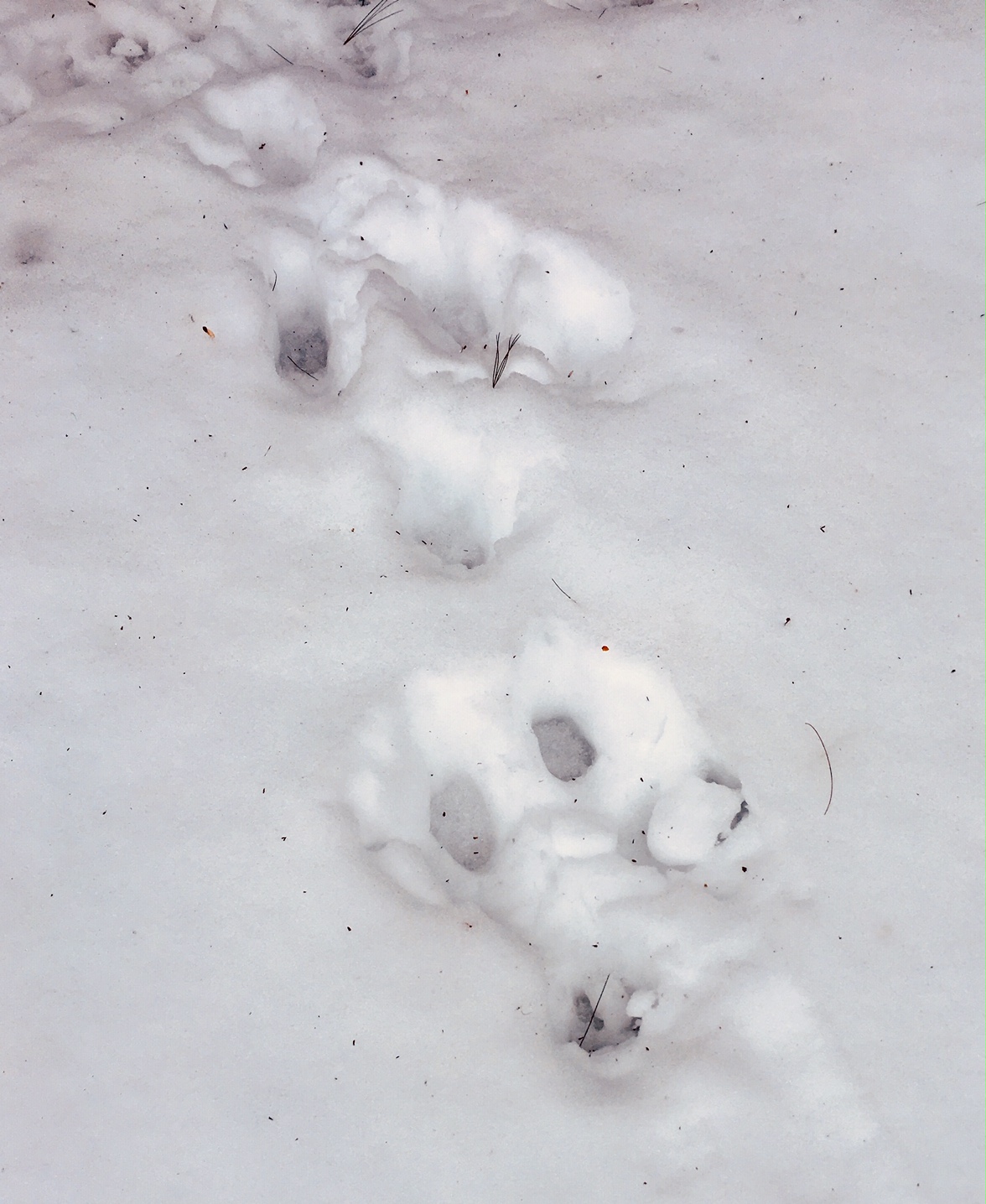
Today, I examined footprints in the slushy snow near the deck. Were these Corgi footprints close together, or something larger? I assume it has been warm enough to rouse a bear from torpor. Every print was indistinct, shadowy. I don’t think any were bear tracks. The bear might have been far enough away not to leave tracks near the deck, but close enough for Violet to pick up the scent.
Which is scarier, the bear you see, or the bear you don’t see?
This Land is My Land
- Details
- Written by PEEC - Janine
- Category: PEEC Blog
A Naif in the Forest by Darrell Berger
Wing Tips to Hiking Boots: Musings of a New, Full-Time Poconos Resident
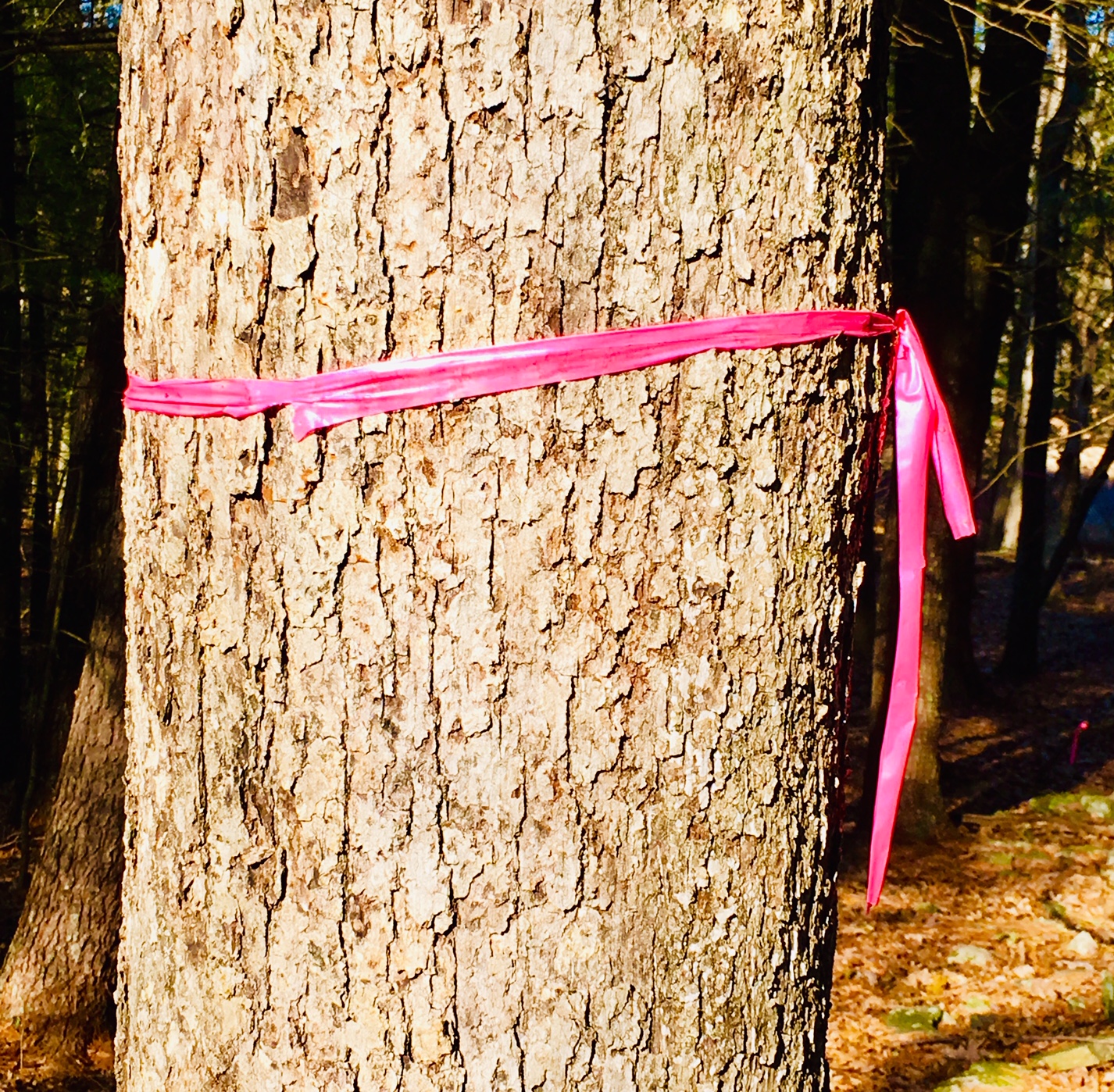
The finch turns from gold to gray, leaves from green to red and orange, moss fades, the ground itself wears a white blanket then throws it off. The bright, pink plastic ribbon around the tree never changes. It blends with the fall, stands alone as the only color in winter, reflects like psychedelic neon against the angle of the setting sun in any season.
It doesn’t fade or bloom or wilt or open because it doesn’t live, so never dies. It wraps around trunks, dangles from branches, flies from rebar spikes hammered into the ground. It gives new meaning to the first line of Woody Guthrie’s most famous song: “This land is your land. This land is my land.” On one side of the pink tape is your land. The other side is mine.
Flagging or surveyor’s tape does have something in common with birds and leaves. It comes in many colors and one needs to know the code for proper identification. In most cases, red means power lines, orange communication, yellow utility, green sewer or drains, blue potable water, purple reclaimed water or slurry.
White may be the most ominous, often indicating future excavation. The tapes can also be used in forestry for indicating trees that need to be taken down, or not. Hikers, hunters and paint ballers use them to indicate trails and directions.
These human intrusions are the only colors in the forest that seem out of place and crudely rendered compared to the subtly and variety of organic color and form. I am fortunate that in my part of the forest no one cares if Violet the Corgi and I venture onto their property, as we often do on squirrel patrol, to visit the creek, chase a tennis ball, or just stretch our legs and enjoy nature.
Near us there are only pink property line indicators. Nobody removes the tape. We respect private property. This land is my land. That is my neighbor’s. Good to know. Good also to remember that the forest doesn’t care.