

A blog focused on nature, science, environmental topics, and happenings at the Pocono Environmental Education Center (PEEC).
Sometimes Gold Returns
- Details
- Written by PEEC - Janine
- Category: PEEC Blog
A Naif in the Forest by Darrell Berger
Wing Tips to Hiking Boots: Musings of a New, Full-Time Poconos Resident
When March arrived without a trace of spring, I began to look for subtler signs. I found some on the golden yellow of the pine siskin, applied as an accenting coat, streaked randomly along tail feathers, breast and wings. It is a cousin to the goldfinch, who now also begins to turn from its drab winter coloring to bright yellow.
I find both around our feeders constantly. I recently discovered everybody isn’t a goldfinch. Their differences are obvious, once you see them, though both are finches. Our siskins and goldfinches have more golden yellow feathers today than four days ago, when this photograph was taken.
Feathery gold is accumulating now, each day more and brighter, a seasonal optimism. While the goldfinch doesn’t migrate, the siskin sometimes does, depending on weather and food availability. The golden colors of both birds return gradually. The siskin flies north, though ours seem to stay all year; the finch molts in place.
Robert Frost wrote: “Nature’s first green is gold, Her hardest hue to hold.” Gold and brightest yellow in nature seem ever receding, as Frost states in the final line of the poem which is also its title: “Nothing Gold can Stay.” However, I have a prosaic codicil to add.
It is, “Sometimes gold returns.” It returns with the siskin. It returns with the spring molt of the goldfinch. Even gold, immutable, is subject to eternal return. You just have to know where to look for it.

Photo by Kathleen Lyon
Zen Woodsman
- Details
- Written by PEEC - Janine
- Category: PEEC Blog
A Naif in the Forest by Darrell Berger
Wing Tips to Hiking Boots: Musings of a New, Full-Time Poconos Resident
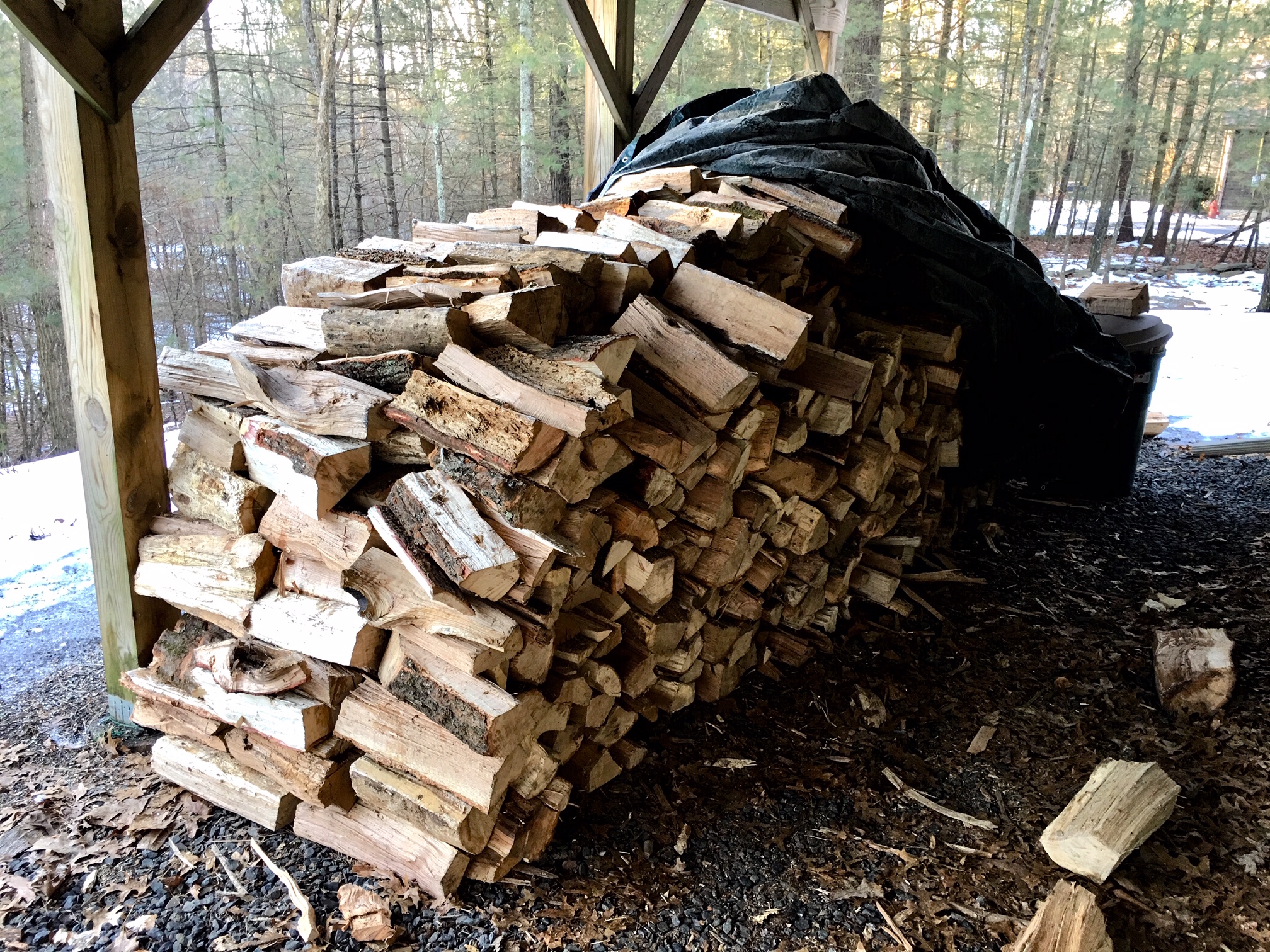
Two cords of wood are stacked under our deck. This will get us through the winter and into the fall. Having enough firewood is a comfort.
The delivery truck backed up our driveway, an impressive feat, dumping the wood close to the deck. Then came the job of stacking.
I’m a tad obsessive. I fold clothes. I adjust crooked picture frames. I recently arranged the contents of our pantry according to container: boxes on one shelf, bags on another. Transforming a pile of firewood into a stack calls to me.
All wood deliveries are not equally easy to stack. Some cords arrive with uniform pieces. Others have various sizes and shapes. These bring greater challenges and frustrations.
The most frustrating aspect of wood stacking now is that I simply can’t complete the task. Or, more precisely, completing it would take too long. I need the wood under the deck before the next snow arrives, which will be soon.
I am reminded of Mr. Winifred Chestnutt, my neighbor when I lived in North Carolina during the Carter administration. He was 92. Every day he would be on his land, falling timber, cutting and stacking. I asked him how he could do this every day at his age. “When I get tired, I stop. When I feel better, I go back to work.”
I’m not good at either. I usually work too hard and then give up. I phoned my friend and neighbor, who stacked the wood for a fee far less than the chiropractor would charge to get the kinks out of my back, would I be so foolhardy as to try to finish the task. With the next storm imminent, my only choices were to work too hard or find someone else to work too hard.
Next year I’ll try another strategy: work smarter. Order more wood, sooner. Next year I hope to have time to stack the wood myself into an orderly, properly obsessive stack before the storm arrives. I might finally attain the Zen woodsman consciousness of Mr. Winifred.
Earth Tones
- Details
- Written by PEEC - Janine
- Category: PEEC Blog
A Naif in the Forest by Darrell Berger
Wing Tips to Hiking Boots: Musings of a New, Full-Time Poconos Resident
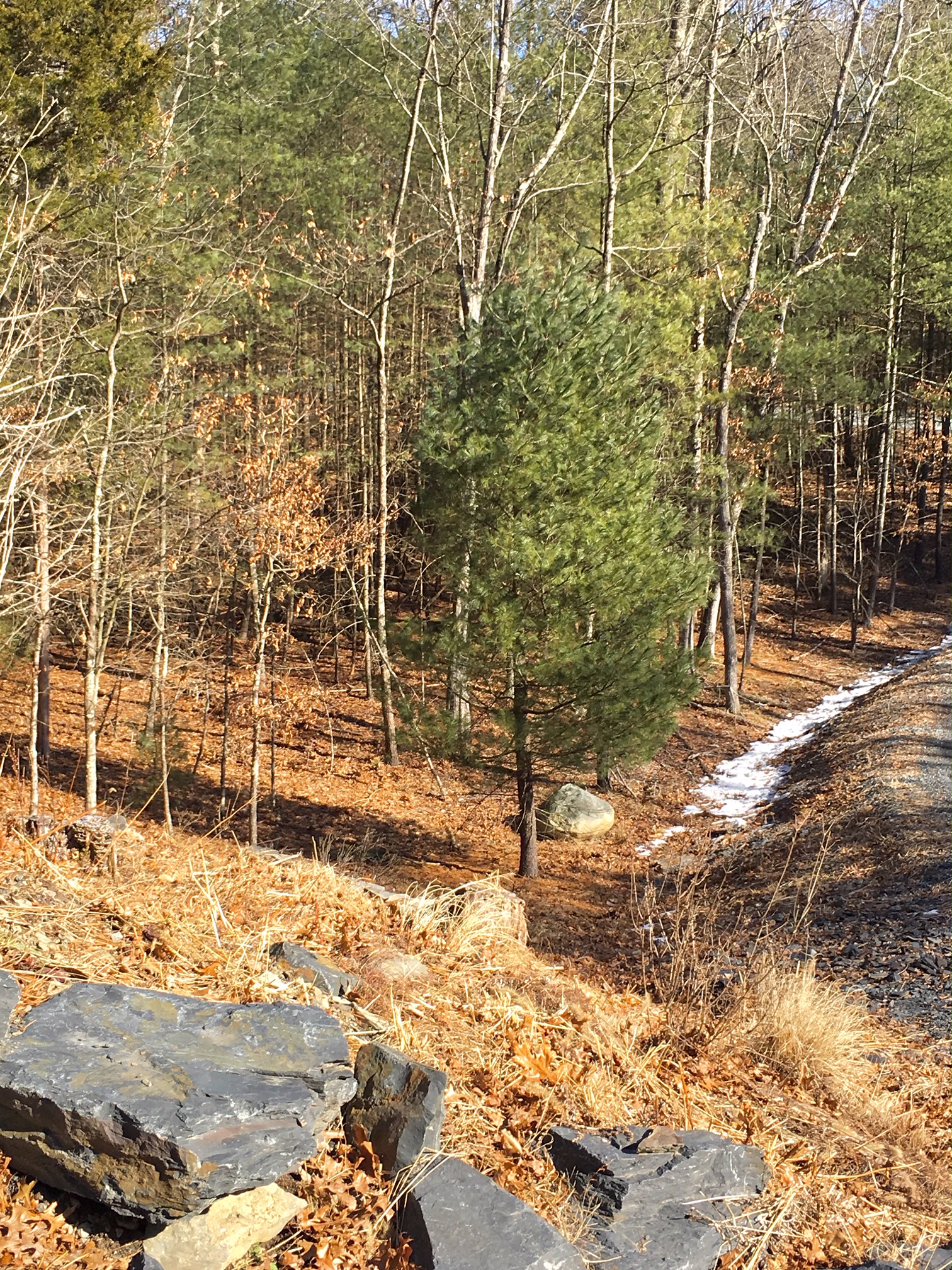
While driving home from the city last week, I noticed that the recent thaw allowed a rare winter landscape in colors other than white. The mountains glowed with rich browns, bright yellows and deep greens. They were repeated in my part of the forest, especially when the sun was out and the grasses and long-fallen leaves were painted with cadmium and Naples yellow.
The colors surprised me. I had assumed a winter landscape in the Poconos that was not white would be drab and lifeless. When the sky is cloudy, as it is so often, it appears exactly that. When the same bright sun that melted the snow stays long enough to shine on the colors of the dormant landscape, the result can be as beautiful as the brightness of spring or the vivid array of the fall.
If spring is dominated by colors of budding plants and fall by their demise, then the winter landscape is dominated by the earth. Plants have receded, allowing the deeper ochre, umber, sienna, Payne’s gray and almost black to have their moments among the rocks.
An earth color or tone is sometimes described as any color with some brown in it. Many earth tones are named for animals, like fox, lion or buckskin. “Taupe” is French for mole. The sap greens and viridian of the pines show the mature needles at the end of life, rather than the lighter, brighter hues of new growth.
I was beginning to enjoy this rare palette when the next snow arrived and again white covered everything, a more natural order for this place and season. By the time we see the earth’s surface again, it is likely to be during a false spring in a disappointing and annoying March, or when again we discover that, much as we love spring, baseball in April is a trial.
Then new buds will be visible, daffodils more than a dream. Planting will demand its annual urgency. The earth colors will recede like grandparents at a graduation party, the foundation of all the activity, their work complete.
High Water Mark
- Details
- Written by PEEC - Janine
- Category: PEEC Blog
A Naif in the Forest by Darrell Berger
Wing Tips to Hiking Boots: Musings of a New, Full-Time Poconos Resident
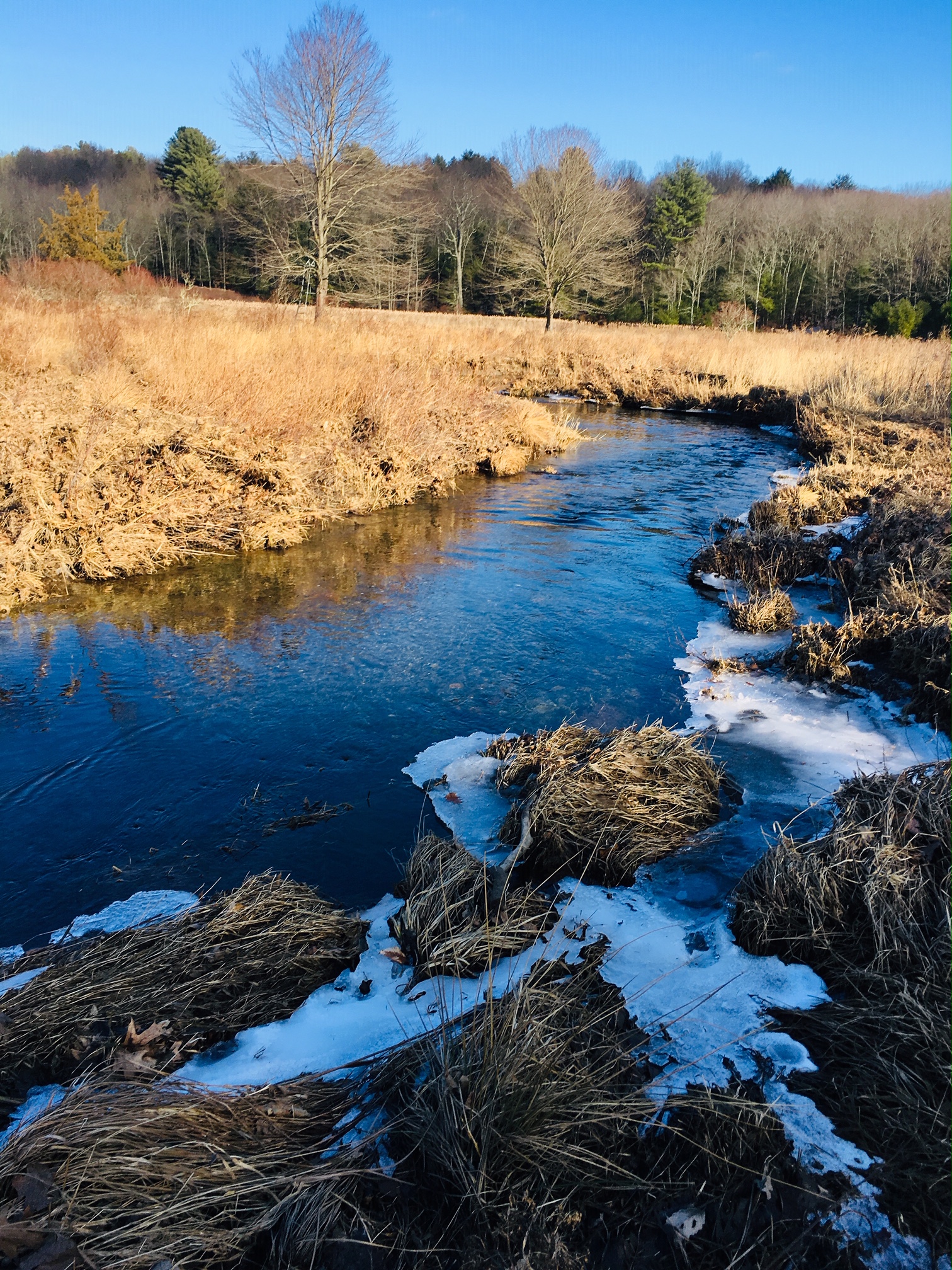
This is Hornbeck’s Creek near my part of the forest, the day the temperature reached the mid-60’s. Three days before my thermometer registered -8. I’ve never experienced a more than seventy-degree change within three days.
This is also the highest water level I’ve ever seen, except for last spring when a beaver temporarily turned the creek into wetlands. Usually I see this level in April, after the spring thaw. Since the recent warm spell melted most of the snow, I call this the “winter thaw.”
This isn’t all bad. I’m happy to have no ice and snow on the roads and driveways. The next storm will have to start from scratch, not build on already accumulated ice, which is what makes local travel dangerous.
Yet, if the amount of precipitation continues as it has since last summer’s imitation of a sub-tropical rain forest, the winter thaw might be followed by another new term, “the spring flood.”
That won’t bother me much. We live up the mountain from the creek and the worst thing would be that Violet the Corgi would lose her nearest wading pool. Our neighbors, however, who live just to the left of this photo, might not be so lucky. A few inches change in the peak level of the creek might bring water into their back yards, perhaps into their homes.
It remains to be seen if “winter thaw” and “spring flood” become permanently descriptive terms in the forest. Are the most recent seasons anomalies or, to use a current term, “the new normal?”
The old saying, “Everybody talks about the weather, but nobody does anything about it,” was coined either by Mark Twain or his friend Charles Dudley Warner, the editor of the Hartford Courant, in about 1897. A century ago this was humorous, as doing something about the weather was so obviously out of the realm of human possibility. Today, as the high water from the creek flows to the Delaware, humans actually can do something about the weather. Twain or Warner’s phrase has changed from witty to tragic.
Why did the Egret Cross the Road?
- Details
- Written by PEEC - Janine
- Category: PEEC Blog
A Naif in the Forest by Darrell Berger
Wing Tips to Hiking Boots: Musings of a New, Full-Time Poconos Resident
Last week the Naif in the Forest was the Naif in Florida, but fear not, I have returned in time for the sub-zero weather. While basking in the very rainy but sixty degree grayness which locals described as “the worst weekend here in four years,” my wife and I enjoyed the Morikami Japanese Gardens in Delray Beach during a brief sunny interval. We saw a snowy egret walk very, very slowly across the path. He peered into the bush and stared for a long time, completely still.
Suddenly, he pierced his head into the bush and emerged with a wiggly lizard, desperate to escape. He turned his beak upward and the lizard gradually slid down and down, still wiggling. One could see his journey down the egret’s slim neck, wiggling no more. The reptile disappeared into the egret’s stomach. The bird then moved equally slowly to another bush and another lizard. Finally, he turned around and briefly stared right at me, before he returned to the side of the path I had first seen him. That stare, given what I had just observed, was terrifying.
As he stared at me I thought, “I’m really glad this bird isn’t eighty feet tall,” because if he were, I’d be headed for the fate of the lizards. I recalled that these guys had once been dinosaurs. Even T-Rex was only about 20 feet tall so I might not have been swallowed whole, but still.
Our stroll through the gardens was very meditative and restorative, except for that one incident of nature’s insistent brutality played out before my overactive imagination. We adjourned for lunch to the beautiful restaurant overlooking the gardens.
I ordered a bento box, a traditional Japanese lunch, including shrimp, salmon and chicken. In one lunch, without having to hunt, fish or kill, at least not directly, I devoured far more creatures than the hungry egret. My wife ordered the vegetarian alternative. I should have either done the same, or at least not have recoiled so from the gaze of the lizard-swallowing egret.


