A blog focused on nature, science, environmental topics, and happenings at the Pocono Environmental Education Center (PEEC).
A Dubious Partnership
- Details
- Written by PEEC - Janine
- Category: PEEC Blog
Naif in the Forest by Darrell Berger
Wing Tips to Hiking Boots: Musings of a New, Full-Time Poconos Resident
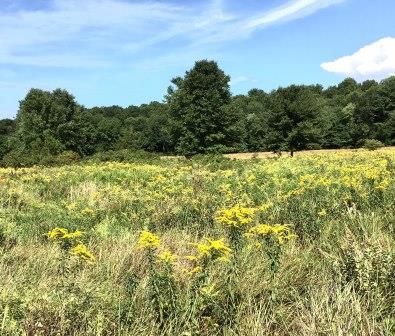
The field near the creek is alive with goldenrod, a sign of fall approaching. That was why the dark yellow writing tablets of my early education were called Goldenrod Tablets.
I walked through the goldenrod without sneezing, convincing me that my severe pollen allergy had improved. A little research taught me that goldenrod is not the cause of allergies. Its pollen is too heavy and sticky to travel far, which is why many varieties of insects love it.
The allergy culprit is goldenrod’s frequent companion, burdened with the unappealing name ragweed. One ragweed plant can produce a billion grains of pollen in one season. The pollen is so light it has been found hundreds of miles out to sea. There are several ways to control ragweed, none of which work.
While ragweed is unwelcome almost everywhere, goldenrod gets a varied reception. It is considered a weed in America, invasive in Germany and China. It is a garden plant in most of Europe, especially in more wildly arranged English gardens.
Goldenrod contains a small quantity of rubber. Edison and Ford spent considerable time and money attempting to use it to make rubber tires, which proved impractical. Ragweed is of the more elegantly named genus ambrosia. There is disagreement among botanists regarding its historic uses. It is a “lost grain,” a plant once cultivated and important to human consumption, but no more.
Ragweed contains raw protein and fat. It grows above the snow, providing an important food source in winter. It has use as an antiseptic, emetic and emollient. Ancient peoples eventually replaced it with easier to grow and prepare grains like corn, soy and wheat.
Goldenrod’s mother might have said, “Stop hanging around ragweed. It will ruin your reputation.” It isn’t ragweed’s fault that it fell from being a sustaining crop, with its only distinguishing characteristic making people sneeze. Goldenrod stood by ragweed and today many people blame it for its companion’s annoyances. Ragweed might say, “I once had class. I was cultivated. I was somebody, not a lost grain, which is what I am.”
A Good Word for the Moth
- Details
- Written by PEEC - Janine
- Category: PEEC Blog
A Naif in the Forest by Darrell Berger
Wing Tips to Hiking Boots: Musings of a New, Full-Time Poconos Resident
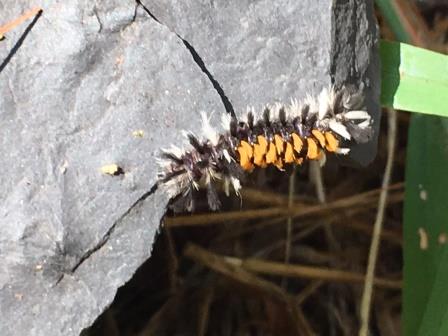
We planted milkweed to attract monarchs. Milkweed is the only thing they eat. We have had some. Last week we also had this creature.
This is a milkweed tussock or tiger moth caterpillar. “Tussock” means tufts of thick hair, “tiger” because of its black and orange stripes. The colors shared by tussocks and monarchs are a defense, announcing to predators they would be wise not to eat them. Milkweed contains a chemical that causes vomiting and in large doses, heart attack and death.
The tussock moth caterpillar is prey to bats, so they emit a sonic warning signal. They prefer mature milkweed plants. Milkweed grows very fast, a necessity for it to survive being the food source of fast-eating caterpillars.
Tussock caterpillars appear in late summer or early fall and survive winter in cocoons. In spring a grey moth appears, which I find to be an appealing taupe, with a tasteful black and orange center stripe, like wearing a school tie suggesting the colors of one’s youth.
The monarch and the moth survive together peacefully on the milkweed. Both are native to the areas they inhabit, though there are several on line questions asking, “How do I get rid of milkweed tussock moths?” Apparently some people prefer the bright and bold monarch to the subtle grays of the moth. Others may simply like butterflies better than moths. While some moths can be troublesome, the milkweed tussock is not among them, unless they are eaten, which means the predator has overlooked both warning colors and sonic discouragements.
I could not discern the caterpillar’s front from its back, other than by assuming it was moving forward. I found it both beautiful and fascinating in its unusual adornments. I didn’t exactly know what to make of it, whereas the monarch in all its stages is familiar, loved, its presence cultivated.
Invite the butterfly, the moth also appears. One does not have a more valid claim to the milkweed. One is not more poisonous than the other. The moth and butterfly are not rivals, but neighbors.
Time Enough
- Details
- Written by PEEC - Janine
- Category: PEEC Blog
A Naif in the Forest by Darrell Berger
Wing Tips to Hiking Boots: Musings of a New, Full-Time Poconos Resident
It is not difficult for me to get close to a butterfly unless I’m trying to take its picture. There is something predatory in the way I approach them with my smart phone. It looks suspicious. I only achieved this photo because he was obsessed by his flower.
These species of butterfly and flower are both attracted to sunlight. The butterfly seeks the light, often flying high above the leaf canopy. They represent my part of the forest in the full, bright bloom of summer.
My first guess at identification was wrong. He is neither a monarch nor a false monarch, also known as a viceroy. He has the markings, shape and color of a male tiger swallowtail, except for the swallowtail. One might think this disqualifying. It is not. The tail may vary from quite long to almost non-existent. There are Eastern and Western varieties, which one must be advanced beyond the naïf stage to discern.
They are forest dwellers, bigger than monarchs. They love pink or red flowers and are here lunching on beebalm, also called bergamot, horsemint, oswego tea or Monarda, after the Spanish author of a book on plants of the New World in 1574. It was used by Native Americans as a general antiseptic and contains chemicals used in commercial antiseptics today.
Tiger swallowtails have evolved a few protections, as birds find them delicious. Their caterpillars have two large spots on the top of their heads that resemble eyes, and emit a foul odor from an appendage that looks like a tongue. Birds mistake them for snakes. The adults resemble a poisonous cousin.
The butterfly stage of the tiger swallowtail is about two weeks, which is also how long it takes for them to go through its earlier stages. This doesn’t seem very long to us, just as, perhaps, our life span seems sadly short to a three hundred year old beech tree. One can only conclude that life spans are as nature intended. If I have two weeks, living them as a butterfly seems lovely.

Steeplebush
- Details
- Written by PEEC - Janine
- Category: PEEC Blog
Naif in the Forest by Darrell Berger
Wing Tips to Hiking Boots: Musings of a New, Full-Time Poconos Resident
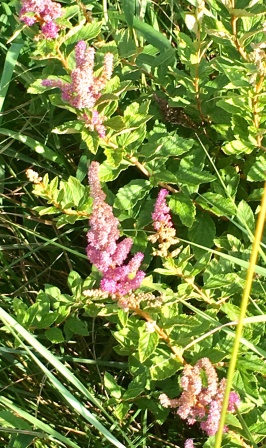
Constant spring rain and intense, if periodic, summer sun have encouraged the grasses and bushes on both sides of the creek to heights I had not seen. Their greens and browns are sprinkled with the bright pinks of the steeplebush.
The steeplebush is a tall plant that attracts attention only with its narrow, spike-like clusters of color that appear in late June or July. It grows wild here but is sufficiently attractive that their seeds can also be purchased for gardens. It used to be called hardhack, as farmers had difficulty cutting it back.
In another culture it might have been called pyramid bush, or arrowhead. Its leaves serve a medicinal function as an astringent. Butterflies and other nectar-feeding insects love them, so creek walkers can find in mid-summer a blast of colors emanating from a butterfly at work on a steeplebush cluster.
“Steeple Bush” is also the name of one of Robert Frost’s last collection of poems, published in 1947. This man whose life was filled with melancholy, even depression, dedicated the volume to his grandchildren and therefore, to the future.
The first stanza of the second poem includes, “steeple bush is not good to eat, Will have crowded out the edible grass.” He continues with describing how the trees will replace the bushes, and the plow with fall the trees, then the grasses will return in “a cycle we’ll say of a hundred years.” He advocates patience and leaving time to take its course. The final couplet is “Hope may not nourish a cow or horse, but specs alit agricolam ‘tis said.”
“Specs alit agricolam” is the motto of a very old British farming family. It translates “Hope sustains the farmer.” The colors of the steeplebush, its nectar that attracts more color to it, enlivens the landscape like specs of hope in a green field of, at best, indifference.
Today I scan the news, looking for something to sustain me. If I read any small message as reassuringly lovely as a butterfly on a steeplebush amidst a field of weeds, I am comforted. Hope sustains us all.
A Garden Harmonizer
- Details
- Written by PEEC - Janine
- Category: PEEC Blog
Naif in the Forest by Darrell Berger
Wing Tips to Hiking Boots: Musings of a New, Full-Time Poconos Resident
My first encounter with purslane was as an invasive weed in our driveway. I went to some trouble to remove it, without success.
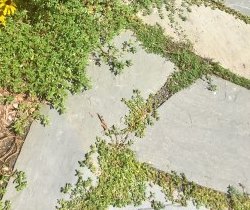
It spread to our stone walk. If I pulled the larger stems, the smaller formed a rather attractive green border, so I left it. When it spread up the side of the garden, it appeared it would take over every open space. I started pulling again.
Enough eventually spread that it didn’t look like a weed any more. It looked like ground cover. It was a soft, textured mat for our several bushes and flowers. Like The Dude’s living room rug in “The Big Lebowski,” it pulled everything together.
Then a friend who is an expert in the forest told me it was edible! Pliny the Elder, the natural philosopher of the first century, called eating purslane a way “to expel all evil.” That might have been his pre-scientific way of explaining how healthy it is, containing a remarkable combination of omega three fatty acids, antioxidants and minerals.
I gathered some and began to prepare it for dinner. I discovered that pulling the leaves and smaller stems from the larger was almost as tedious as weeding them from the driveway. When I was finished, the large bowl of purslane had shrunk to a pathetically small amount that was edible.
I sautéed it by itself, wanting to acquaint myself with it, unsullied by more familiar flavors and textures. It did, as I had read, taste a bit like okra without the viscosity. The taste was strong for its volume, like it would play well with others. Next time I’ll make sure to pick only from the largest plants, to reduce preparation time, and to mix it with other greens.
A weed when it stands alone, this succulent becomes an attractive ground cover when it surrounds more colorful plants. Palatable but slightly bitter as a solo, it adds flavor to other greens in the frying pan. Purslane, kale and chard harmonize very well. Purslane is the David Crosby of invasive weeds.
** Warning: Please do not pick & eat any forest plant, without the advice of an expert.