A blog focused on nature, science, environmental topics, and happenings at the Pocono Environmental Education Center (PEEC).
Oh, Deer!
- Details
- Written by PEEC - Janine
- Category: PEEC Blog
A Naif in the Forest by Darrell Berger
Wing Tips to Hiking Boots: Musings of a New, Full-Time Poconos Resident
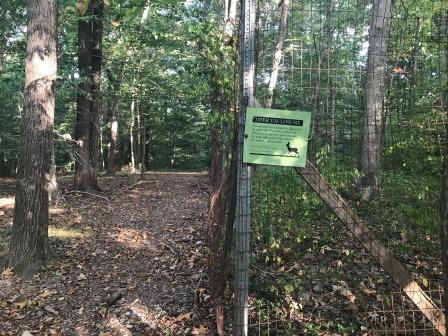
This photo shows a deer exclosure in Rockville, Maryland, a suburb of sixty-eight thousand people seventeen miles from Washington, DC. Rockville both values its modern conveniences and protects its natural beauty. As a result, there are deer.
To the left in this photo one sees a forest similar to ours. Behind the fence, the deer are kept out and the forest becomes magnificently more bountiful with a diversity of plant life.
Humans have short memories. It is easy to assume that the way our forest looks now is the way it has always looked. Not so. In earlier times our deer population was lower compared to their grazing range, and the vegetation similar to that within the exclosure.
The Commonwealth of Pennsylvania has long built similar exclosures to allow for plant regeneration. Many of us build high fences around gardens and cover flowers and bushes with webbing and noxious fluids to keep deer away.
There are two kinds of articles on the internet about deer and their environment. One describes efforts to keep deer away, the other efforts to attract them. Apparently there are only two quantities of deer: too many or too few. If there is an exactly right number of deer, apparently it is impossible to maintain.
I love to see deer in the back yard and hills. I hate what they do to our garden. I don’t love wearing a bright orange hat or vest during hunting season. Violet the Corgi barely tolerates her similar vest. I know, however, the hunters are doing a useful job for the forest, one once done by wolves and other predators.
The practical job of preserving the forest is seldom aligned with what is most beautiful or convenient or fun or profitable for human beings. It is difficult for human beings to put their collective desires aside, merely to preserve the air they breathe and the water they drink. Might it transpire in some future world, when artificial intelligence has everything figured out, the environment will benefit from exclosures for humans?
Fear Itself
- Details
- Written by PEEC - Janine
- Category: PEEC Blog
A Naif in the Forest by Darrell Berger
Wing Tips to Hiking Boots: Musings of a New, Full-Time Poconos Resident
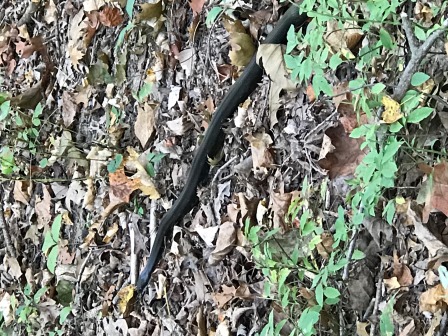
This is the first snake I have featured. Those I have seen in my part of the forest are too small and fast. By the time I see one, it is gone, under a log or into one of our fieldstone walls. This guy was taking his time, crossing the hiking path last week when we were visiting central Maryland. I wanted to walk away as fast as possible. My wife followed it and snapped this photograph. She is brave.
I escort insects outdoors. I apologize to toads when my weed whacking approaches. I move mouse nests gently from grills and leave spider webs alone until abandoned. I’m not overly afraid of bears, at least so far. If I see a snake of any size I walk in the opposite direction immediately.
As with many varieties of fear, my response is fueled by ignorance. I don’t know which came first. I encountered no snakes where I grew up in northwestern Ohio. I didn’t see many until I moved to coastal North Carolina. I once went fishing on the aptly named Cape Fear River. Several very large snakes fell into our boat from the tree branches above. The local fellow I was with just pitched them overboard, as though they were but a mild annoyance. I did not fish with him again.
My usual curiosity does not extend to snakes. I just don’t want to be around them. My wife’s web search concluded this is likely a rat snake, of no danger to humans. She found this out after running toward him to get a photograph.
Some of the little snakes I see around here are probably rat snakes, too. They grow larger in warmer climates, and are therefore benefitting from climate change. This one was probably five feet long. They grow to more then eight feet and are constrictors, feeding mostly on rodents and birds. They are found almost everywhere in Pennsylvania.
Thanks to my wife’s intrepid photographing my snake ignorance is slightly less and therefore my snake fear, too. It’s a start.
What it Takes to Migrate
- Details
- Written by PEEC - Janine
- Category: PEEC Blog
A Naif in the Forest by Darrell Berger
Wing Tips to Hiking Boots: Musings of a New, Full-Time Poconos Resident
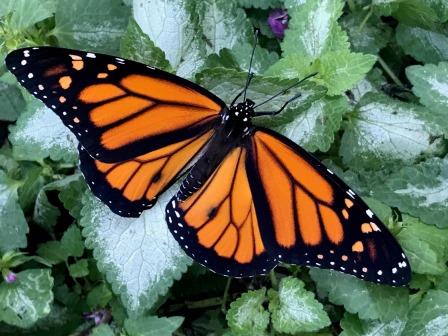
I was jealous of my wife for taking such a great photograph of a male Monarch butterfly. I had tried repeatedly in the spring, but they proved too busy. I rationalized this by concluding that her fall butterfly was geriatric and less elusive. I was wrong. This guy was just getting started.
Monarchs are the greatest among butterflies that migrate, traveling as much as three thousand miles. Migration begins in the fall. This fellow will soon begin heading south. In three weeks he will arrive in Mexico, where he will spend most of his life in near hibernation. Then he will stir himself, mate and die, having lived as a butterfly Methuselah, six to eight months, compared to the six to eight weeks that most survive, if they are lucky.
His children will find Texas or Oklahoma, then reproduce, all within the normal life span of a couple months. The grandchildren will arrive in the mid-Atlantic states and their offspring will return to our part of the forest, or into Canada in time to welcome spring. The great-grandchildren will repeat the long voyage south, and be given the extended lifespan required.
Monarchs received their name from King William III of England, also known as William of Orange. The Viceroy butterfly is often mistaken for a Monarch. It has a black bar across the lower part of its wings, which the real Monarch lacks. The Monarch’s black and orange colors of both butterfly and caterpillar signify “don’t eat me. I’m poisonous.” Most predators will not eat a second Monarch. Even so, only about ten percent of Monarch eggs, pupa or caterpillars survive to adulthood. Today they are threatened by land development that takes away their milkweed home and climate change that confounds their migrations. Their numbers are down over 80% in the last twenty years.
The long-lived Monarch appears undistinguishable from the other generations. Yet there is something inside that allows them to travel and endure far beyond its ancestors or descendents, a greatest generation of butterflies, appearing every fall.
Never Pet a Green Caterpillar
- Details
- Written by PEEC - Janine
- Category: PEEC Blog
A Naif in the Forest by Darrell Berger
Wing Tips to Hiking Boots: Musings of a New, Full-Time Poconos Resident
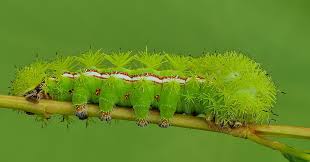
There was a large green caterpillar in the middle of our front door threshold. I attempted to move it from harm’s way. I gathered it into my hand. I immediately felt a sharp sting. I deposited it into the nearest grass.
I ran to my computer and searched “green caterpillar stings.” It was an Io moth caterpillar. It has poisonous quills. No kidding.
Standard treatment: place tape over the wound and pull, removing the quills. Wash with soap and water; apply cortisone cream to the infected area. It now felt like only a mild bee sting. Then I noticed the pain in my chest.
I read that caterpillar stings may cause difficulty in breathing for people with asthma, of which I have a touch. I couldn’t find exactly how worried I should be that my breathing had become labored. It said it was important to be calm and not panic. I had hoped panic would be useful.
I decided to lie still for one hour. By then this should have passed. If it had not I assumed I would still be able to drive for medical assistance or at least prevail upon a neighbor. I calculated there was some small possibility I would be asphyxiated by caterpillar venom and look really, really stupid in my obituary.
In an hour I was fine, breathing normally. I seemed to have been stung by only one quill. Had the caterpillar unloaded its full arsenal, who knows?
Regular readers might remember when I wrote about removing an Io moth from my threshold, which had been stunned by flying into my glass door. I moved it to a nearby bush, where it soon recovered and flew away. This is the thanks I get. I discovered that green caterpillars are often venomous, while brown almost never are. This caterpillar had been a bigger threat to me than any bear or snake I had yet encountered.
Heretofore my ignorance of the forest has been interesting to me. Today I found it also could be dangerous.
A Plague of Misinformation
- Details
- Written by PEEC - Janine
- Category: PEEC Blog
Naif in the Forest by Darrell Berger
Wing Tips to Hiking Boots: Musings of a New, Full-Time Poconos Resident
Until this week I thought locust, cicada and katydid were different names for the same critter, like pop, soft drink and soda all indicated carbonated beverages. Regional differences. Wrong.
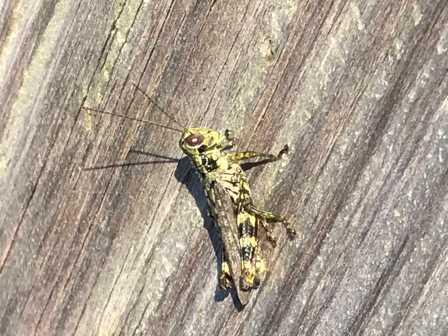
This is a locust. I think. A cicada looks like a big, scary fly. When I was a boy in northwestern Ohio I saw lots of outgrown nymphal exoskeletons of cicadas at the beginning of fall. Everybody called them locusts. I thought “cicada” was the scientific name for locust.
This persistent misidentification has long been common in the United States. England has only one species of cicada. They are little noted as their mating call frequency is above human hearing. When English colonialists observed the American cicadas’ swarming cycle, it proved so alarming they thought they were observing a biblical plague of locusts.
A real plague of locusts is significantly scarier and more destructive than the swarming cycles of cicadas. Locusts are usually solitary creatures, until they experience a food shortage. Then they transform. They start to follow each other in the same direction in search of food. They even change size and color, like Bruce Banner becoming The Hulk. Locusts will strip a field bare, and cause food shortages for humans.
I still equate the loud sounds of insects at dusk with the ending of summer and the beginning of school. This sound is largely cicadas. The soft buzzing sound of locusts may add harmony. Katydids provide a raspy, higher-pitched percussion, their mating call. “Katydid” is not a folk name for cicadas or locusts, as I also mistakenly thought. They are cricket-like and include over six thousand species, most of which are light green.
The forest sounds of approaching autumn are more variegated and complex than I imaged. What I thought were locusts are many species of several different distinct animals. The older I get, the wiser it seems to consider the possibility that on almost any fact, I might be completely wrong. The things I am most likely to be wrong about are the things I have been sure about the longest.