

A blog focused on nature, science, environmental topics, and happenings at the Pocono Environmental Education Center (PEEC).
Why did the Turkey Cross the Road?
- Details
- Written by PEEC - Janine
- Category: PEEC Blog
Naif in the Forest by Darrell Berger
Wing Tips to Hiking Boots: Musings of a New, Full-Time Poconos Resident
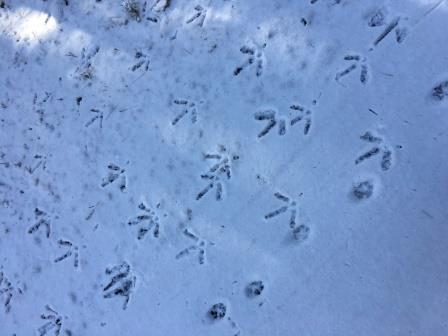
I found turkey tracks in the fresh snow by the edge of the road. Three large toes point forward, one small toe points back leaving barely an indentation. The tracks indicated three birds. One ventured down our driveway before retreating.
Wild turkeys are not the impressive specimens depicted through generations of Thanksgiving decorations in countless elementary school classrooms. Maybe the turkeys I see haven’t had enough to eat, or they had come upon hard times as a species, and the impressive birds of my youth were no more. Turns out these formidable birds still exist. I have probably seen many, just not in the proper circumstances.
The traditional holiday image is a male turkey in his full display of dominance, ready to mate with as many females as possible and fight other males for the privilege. It is only in this mood that the turkey gobbles. It is his mating call. Turkeys also make a number of other sounds, including clucks, cackles, purrs and whines. One is unlikely to see turkeys in a mating and dominance mode while foraging along a road.
The strutting male turkey is no more typical of turkeys than is Teddy Roosevelt, his chest expanded, astride a mighty steed at the Museum of Natural History, typical of Americans.
Turkeys have a large number of predators. Both males and females fight valiantly to protect their eggs. They have been known to attack humans, alligators and bears, and fly fast enough to discourage hawks. They don’t migrate and forage for nuts and berries year round. They sleep in trees, and in groups of a dozen or more. They have excellent sight in the day, but poor night vision. They find safety in numbers and the lower branches of trees.
Like so many species, including the human, the turkey is often represented only by a dominant male. A more realistic depiction would be to show both males and females with feathers at rest, foraging in a clearing, caring for and protecting their young, looking for food and trying not to be eaten.
I’m Dreaming of a Brown January
- Details
- Written by PEEC - Janine
- Category: PEEC Blog
A Naif in the Forest by Darrell Berger
Wing Tips to Hiking Boots: Musings of a New, Full-Time Poconos Resident
My favorite “White Christmas” is the Drifters’, with Clyde McPhatter on the high part and Bill Pinckney on the low. Now that Christmas is behind us, I’m dreaming of a brown January. There is no song to celebrate this dream.
The photo that appeared here recently, with icy branches sparkling like jewels against an impossibly bright blue sky, could only be seen as beautiful if you didn’t have to walk or drive through it. Even in the summer our driveway is a challenge. Snow and ice raise the stakes from challenging to dangerous. There are usually several winter days I hope arrive with my calendar empty. I support the local custom of staying home when weather requires.
Therefore, among my favorite holiday gifts this year were several days with temperatures in the mid-forties. All the dangerous beauty melted, revealing many shades of decaying brown, upon which it is perfectly safe to drive, walk, play with dogs and transport one’s trash cans to the road. The hibernating bears, skunks, snakes, groundhogs, bats, turtles and chipmunk might even get fooled. In fact, who actually hibernates and who just sleeps really, really well is a debate among scientists.
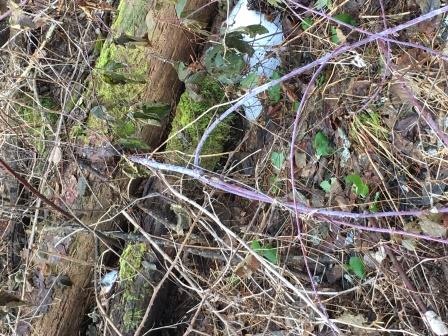
An examination of winter colors other than white reveals beauty and variety not commemorated in song or celebration. Purple vines cross the bright greens of lichen and moss. These colors don’t need the sun. They are vivid, though often hidden, like shy children. The landscape appears soft, countless shades of gray and brown. Streams and creeks are melted sufficiently for dogs to splash, cold enough for them not to linger. No wading, but no slipping and sliding on ice, either.
The days lengthen, but only astronomers notice. The rest of us ease into the light a few extra minutes each day. Today’s palette of earth tones will be covered and exposed by several snows before new sprouts appear and animals return to action. Until then I will enjoy the activity of brown days, and try to accept the inevitability of the white.
Don’t Deck the Halls with Wintergreen
- Details
- Written by PEEC - Janine
- Category: PEEC Blog
A Naif in the Forest by Darrell Berger
Wing Tips to Hiking Boots: Musings of a New, Full-Time Poconos Resident
I spotted this green ground cover with red berries as my wife and I finished the McDade Trail near route 209. “Is that a variety of holly?” I asked.
“No,” she replied. “Wintergreen.”
Its deep green leaves and bright red berries, still vivid in late fall, caused me to mistake it for holly. There are many differences. Wintergreen is a useful medicinal plant. Native Americans brewed a wintergreen tea to relieve a number of complaints. It has a chemical similarity to aspirin. Holly is, biologically speaking, a noxious weed. Wintergreen is a “creeper,” that is, ground cover. Holly is a “climber,” growing upward.
Wintergreen, which is the older name for “evergreen,” has a proven scientific benefit to humanity. Holly’s value is mostly symbolic. Because it continues to stay green while many of the trees around it succumb to the season, it has long been considered to possess special powers. Holly adorns the garlands of the Druid priest, the candle-lit braids of the Swedish festival of St. Lucia and the Ghost of Christmas Present in “A Christmas Carol.” Even Harry Potter’s wand contains holly. Christians display the holly wreath as symbolic of Christ’s crown of thorns, with the berry representing blood, a relatively recent spin to the much older pagan rites.
Wintergreen does all the healing and holly gets all the attention. This may be because holly is a hardier plant, a small tree or shrub, while wintergreen is a leafy ground cover. Wintergreen is too delicate for foot traffic, growing best in forests or hollows that get lots of moisture but little sun.
Most critically, holly dries well, retaining its firmness, shape and color when cut. Wintergreen clipped and brought indoors simply wilts. You can’t deck the halls with wintergreen. Thus, everybody knows holly and only the discerning recognize wintergreen.
If you want to be noticed, it is better to be a climber than a creeper. It also helps if you can be displayed to good advantage. Meanwhile, the healers stay close to the ground.

Some Gall
- Details
- Written by PEEC - Janine
- Category: PEEC Blog
A Naif in the Forest by Darrell Berger
Wing Tips to Hiking Boots: Musings of a New, Full-Time Poconos Resident
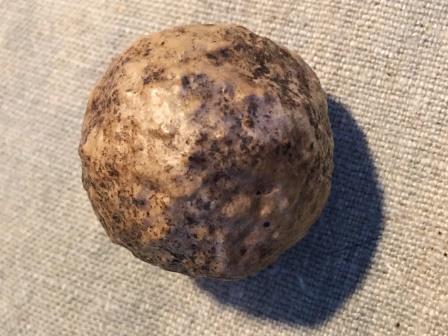
The photo is not of a small planet sitting on my napkin. The day after the last big snow, all was white beneath my feet except for this little brown, round object, one inch in diameter. I thought it might a nut, but it was almost weightless. It perplexed me. Its texture, color and composition seemed tree-like. Its construction seemed shaped by an insect, the way a caterpillar might build a chrysalis or cocoon.
I didn’t know what to call it, so I couldn’t do a web search. “Little round, brown ball of something” wasn’t helpful. I called my friend and expert consultant. Richard Paterson was the Director of Grey Towers in Milford and also Deputy Director of Recreation, Heritage and Wilderness for the Forest Service. If I am a naïf in the forest, Richard is a maven.
Richard informed me I had found an oak marble gall, created by a gall wasp’s work on an oak tree. It is called a marble because it looks like a marble, its nearly perfect roundness rare in nature. The wasp applies its special enzyme to the bud of an oak tree, causing the bud to modify its growth into a sphere, similar to a wart or tumor. The wasp then implants its egg, the gall grows around it, and the new wasp emerges twice a year, usually in September and April, leaving the gall on the tree. My gall, sadly, must have fallen before gestation was complete, as there was no exit hole.
In most cases wasp galls are harmless. The gall itself contains nothing useful to humans, though it is high in tannic acid. Ancient people created ink from these, and some is present in the Dead Sea Scrolls. Sources of superior ink were found centuries ago.
Most wasps prefer to live communally in nests like high-rise condos, everybody up close if not personal. The gall wasp prefers a more singular lifestyle. This oak gall is like a studio apartment or a house in the forest, away from the hives. I get it.
Dangerous Beauty
- Details
- Written by PEEC - Janine
- Category: PEEC Blog
A Naif in the Forest by Darrell Berger
Wing Tips to Hiking Boots: Musings of a New, Full-Time Poconos Resident
I could easily live the rest of my life knowing that the storm of a couple years ago, featuring a foot of snow and seventy mile per hour wind, was the worst I would ever experience. At the very least it enabled me to say of last week’s fifteen inches, ice and twelve mile per hour wind, “It was nothing compared to a couple years ago.”
The contractor who plowed our driveway for years retired to Florida. The new guy’s first effort was good. We used our backup propane generator for most of two days and lost our internet for one. This is about par for a good Poconos’ snow, even though this one arrived early in the season. I tell folks, “It’s not too bad up here in the winter. We don’t usually get much snow until after the first of the year.” I will continue to say this regardless of the facts. I need this to be true.
What else I think is true, but might actually be, is that the most dangerous snowstorms are often also the most beautiful. This photo captured yesterday’s at a moment of rare atmospheric confluence: the ice on the trees was melting, glistening. The sky was clear, sunny and deeply, ridiculously blue. The sun reflected light everywhere. The lower branches in shadow contrasted and emphasized the higher colors and light.
Such a future holiday card photograph only happens during or just after a treacherous storm with particular confluences. Temperatures must dance above freezing and then below, melting snow and then freezing it. The sun must be blindingly bright, no clouds. The weight of the snow and ice bends branches or breaks them. Trees fall onto roofs and power lines, across roads and driveways. Stay off the roads. Stay indoors.
Go into the forest. There is silence. No more power is needed. No need for a phone or computer. Be still. Listen to the trees groan under the weight of the season. The danger of the storm is on the road. The beauty of the storm is in the forest.


