A blog focused on nature, science, environmental topics, and happenings at the Pocono Environmental Education Center (PEEC).
Bad as You Look
- Details
- Written by PEEC - Janine
- Category: PEEC Blog
Naif in the Forest by Darrell Berger
Wing Tips to Hiking Boots: Musings of a New, Full-Time Poconos Resident
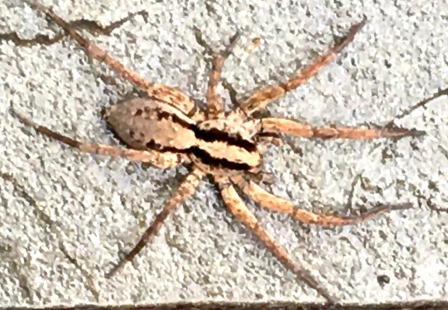
This spider will become far less scary when I tell you it is barely an inch long. I found it on the top of a cardboard box delivered to my door. I tilted the box and the spider crawled away. No spiders or humans were injured.
I had no intention of touching it or trying to get it to crawl into my hand. I learned better recently from the sting I received from the quill of what I assumed was a harmless green caterpillar. Moreover, I feared this was a dangerous brown recluse spider. It was brown. It had a design on its back as I vaguely remembered of recluses.
I was wrong again. Brown wolf spiders are often mistaken for recluses, whose back design is violin-shaped and similar to the wolf’s stripes. A conclusive fact is that the nearest habitat for a recluse is near Cincinnati.
The wolf spider will bite if provoked, its venom no more dangerous than a bee’s. I assumed picking it up might be considered a provocation. I let it dismount from the box at its own pace.
Wolf spiders like woodpiles and outdoor lights that attract prey. The female carries eggs and young on her back, and has excellent vision from two large eyes and six small ones. It does not spin a web, finding its food by outrunning it, which is why it is named for the wolf. Males live a year, females two or three.
Its primary defense is camouflage, its brown coloring blending into woodpiles and cardboard boxes. It also helps to look similar to a very venomous spider. The wisest way to interact with a wolf spider is to leave it alone. I’m discovering this is the wisest approach to many plants and animals of the forest.
I learned long ago, during my years in Manhattan, that “leave it alone” is also wise when encountering members of one’s own species. This is especially advisable for those of us who have relatively weak stings and depend on trying to look more venomous than we are.
Blogging for a Better World: Girl Scouts at PEEC
- Details
- Written by PEEC - Janine
- Category: PEEC Blog
On October 26th, PEEC welcomed over sixty Girl Scouts for a day of badge work and exploration at PEEC. To help our scouts in the badge work of sharing their experience, we ask them to write a few words about their adventures:
“Are you a person of nature and the great outdoors? Well if you are, Pocono Environmental Education Center has beautiful trails and amazing streams. My Girl Scout sisters and I spent the weekend, and even though some of my sisters were anxious, scared, and even worried, we had a great time and I would definitely come back here again. We also learned how to survive the outdoors like, how to walk down the hills and how to tell what was poison ivy. Throughout our trip we made many happy memories and learned about nature and how it is essential for us to take care of the earth. We also learned how we need to pick up after ourselves and leave no trace behind. But, the main thing we learned was how to have fun while respecting nature. “ - Girl Scout Troop # 80783
-Sm.jpg)
“Today we attended a Girl Scout “Badge Fest” at PEEC, to complete our EcoExplorer Badge. We learned a lot about bats and other animals. We learned about extinction and endangered species. We learned that little brown bats and other species of bats are dying from white nose syndrome caused by a European fungus introduced to America in 2006 at a cave convention in New York. Because bats live in caves and in close quarters, the disease is easily spread among them. Scientists are trying to stop the spread and kill the fungus by using things like ultraviolet light and fungicides. They are putting ultraviolet lights in caves to try to expose the nocturnal bats to this light to help kill the fungus on the bats. As part of our activities, we made bat houses to promote the environment of the little brown bat. Bat houses have to be certain colors based on the region of the country that they live in, so that the bats can stay warm enough when they live there and hibernate. They also have to be a certain size to hold enough bats. They must also be stained and not painted so the bats can climb up and cling to the inside of the bat house. We made a large bat house and stained it brown so that the bats can stay warm. We are going to take our bat house home and present it to our local elementary school, where it can be placed on a pole in the pollinator/learning garden we made in 2016. Hopefully bats will live there and the kids can learn about them and we can increase their population. If you would like to help promote the bat population, you can do some research and build your own bat house in your area. You can also plant more pollinator plants so that the food sources of the bats increase. Never try to get rid of a bat population that happens to find its way into your house. Call a professional who is trained in how to safely remove them.” - Girl Scout Troops 50846 and 51408, Newfoundland, PA
“Life in the Bat Cave: This is a bat box. Have you ever seen one? Do you know what it is used for? Do you know why we built this one? Do you know why it is important to save little brown bats here in PA?
We made a visit to the Pocono Environmental Education Center to learn about different environmental issues these little brown bats face as we earned our Eco Explorer Badge. During our day there, we found out all of the answers to these questions and we are happy to share this information with you!
Have you ever seen a bat box? The bat box in this picture is 18 inches wide, 20 inches long and about 2 inches deep. Colors of bat boxes vary depending upon the region it is in. In Canada, Alaska and northern regions where it is colder, bat boxes are black to absorb the sunlight during the day to keep the bats warm. Here in Pennsylvania, bat boxes are brown so that they don’t get too warm. We used stain instead of paint so that the wood remained rough for the bats to be able to grip to. Bat boxes like these should be at least 15 feet off the ground and either attached to a pole or to the side of a building.
Do you know what it is used for and why we built this one? Bats don’t have many predators but that doesn’t stop an owl from swooping and attacking the bats on a tree limb while eating their food. Bat boxes prevent this from happening. The boxes are a great place to safely eat their food. But bats don’t just use bat boxes to eat! This can be called home to up to 100 adult bats for temporary amounts of time!
Do you know why it is important to save little brown bats here in PA? For one, bats are important to biodiversity! They are nature’s bug control! We need them to eat all of those bugs that pester you when you are outside trying to enjoy nature! In one year alone, a bat can eat ONE TON of mosquitoes! These bug eaters are in the top 4 type of bats that are being infected by the white nose syndrome. This is a fungal infection that increases the bat’s body temperature during hibernation. As the bat’s body temperature rises, they wake up and end up dying of starvation because they have no bugs to eat in the winter.
Our one bat box is only going to make a change in the world for these bats, but with your help, saving the bats can become a movement! Bat box building plans are out there on the internet if you would like to make one, two or as many as you want! If you have bats in your home, please have a professional relocate them to a new place. Boarding up their entry hole after the leave at dusk could only trap their babies inside; leaving them alone and hungry. If you feel like exploring a cave, be sure not to disturb them! If you research them, you will find that there are a lot of misconceptions that are just not true; they don’t have rabies, purposely fly in hair, or want to suck your blood.” - Girl Scout Senior Troop 30003/30136
We would like to say thank you to all our Girl Scouts who came out to enjoy a beautiful fall day and we hope to see you again!
Me, I Want a Hula Hoop
- Details
- Written by PEEC - Janine
- Category: PEEC Blog
Naif in the Forest by Darrell Berger
Wing Tips to Hiking Boots: Musings of a New, Full-Time Poconos Resident
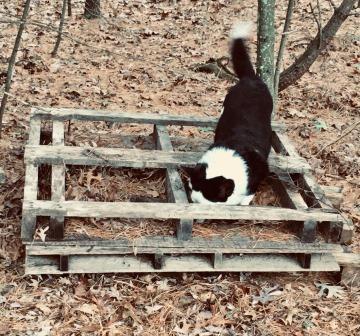
Violet the Corgi is convinced there are chipmunks living in these pallets. She can smell but not see them. I can’t photograph them. She’s been telling me they are everywhere this fall.
Chipmunk populations increase after mild winters and an abundance of acorns and seeds. They also increase when you build special housing for them. Our recently completed stone walls provide countless condos for chipmunks, toads and, small snakes. Recently Violet chased a chipmunk into a small space between stones. I looked into the space with a flashlight. The chipmunk had completely disappeared.
Chipmunk tunnels can be as long as thirty feet. Their homes are divided into bathroom, pantry and bedroom. They are not true hibernators but sleep away most of the winter, awaking only to eat. They make three kinds of sounds, all variations on a “chit” translated roughly as “danger,” “Danger!” and “DANGER!!”
They can gather well over a hundred acorns a day, appearing mostly at dawn and dusk. Their excrement spreads seeds, which is good for tree growth. They also eat bulbs, dig up gardens, and, unfortunately, eat the eggs of songbirds.
Real chipmunks share the qualities of that unavoidable Christmas ditty sung by Alvin and the Chipmunks, logically titled “The Chipmunk Song,” of being both cute and annoying. Maximum annoyance is reached in late fall, when bulbs are being eaten and the lyrics “Christmas, Christmas time is here,” is heard before Thanksgiving. Alvin and the Chipmunks are the best-selling children’s recording group of all time.
The other famous chipmunks are Disney’s Chip and Dale, who first appeared in a cartoon in 1943. Chip is brown, has a black nose and two teeth set closely, while Dale is tan with a red nose and two gapped teeth. Chip is the clever one, Dale not.
Today I saw a chipmunk run a very fast and zig-zaggy pattern before diving into a space between rocks in our wall. I could not discern the color of its fur or nose, nor its dentition. It neither sang nor chitted an alarm. It did seem rather clever.
The Shale on the Trail
- Details
- Written by PEEC - Janine
- Category: PEEC Blog
A Naif in the Forest by Darrell Berger
Wing Tips to Hiking Boots: Musings of a New, Full-Time Poconos Resident
Two Ponds is my favorite trail at PEEC. Its water is horizontal. My wife prefers Tumbling Waters, where the water is vertical. To me, it should be called Tumbling Hiker. I find it too challenging, not for my knees or heart or lungs, but my brain. I often fail to find the right place for my next step.
Our last visit to Tumbling Waters was worse than usual. A hard rain fell two days previously. We did not anticipate that shaded parts of the trail would still be damp. Like a road still dangerous when slightly wet, the trail was a laborious one-step-at-time-it-might-be-slippery experience. When a shady portion happened also to be exposed shale, my uncertainty increased. I decided, since I could not replace my knees, heart, lungs or brain, I would replace my boots.
My erstwhile “new boots” were ten years old. The tread was dead. A visit to outdoor supply stores enlightened me about Vibram. When I tried the boots on, I wanted to test them on an incline that resembled shale. A small and reasonably slick little incline was available. I ascended. It felt like my feet had suction cups. If I didn’t feel secure as Spiderman, at least I no longer felt like the Silver Surfer.
In 1935, Vitale Bramani lost six friends in the Italian Alps who could not descend quickly enough, perishing in a sudden storm. The soles of hiking boots then were leather or felt with hobnails or cleats. Mr. Bramani surmised that rubber, treaded soles would enable quicker and safer climbing, as rubber tires improved upon wooden wheels. Italian tire magnate Leopoldo Pirelli provided the capital and Vibram soles were launched. They were an immediate success and still make the sweetest sole music on many surfaces, including trails and mountains.
I would never think of driving around my part of the forest on worn tires, but I had been hiking on worn soles. On my next hike, whether the water is vertical or horizontal, I will be more confident I will be vertical.
Under Milkweed
- Details
- Written by PEEC - Janine
- Category: PEEC Blog
A Naif in the Forest by Darrell Berger
Wing Tips to Hiking Boots: Musings of a New, Full-Time Poconos Resident
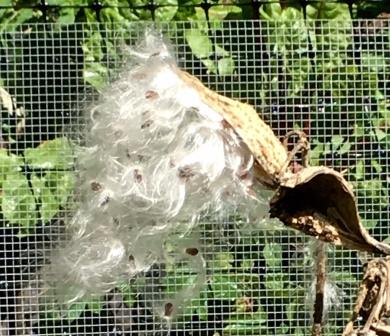
The open milkweed pod with its cottony seeds was an annual fall decoration in the schoolrooms of my early education. Milkweed was among the first plants I could identify. “See,” my father said, “it’s called milkweed because if you break it open it has this fluid that is white, like milk. But don’t taste it! It’s poison.” I have followed his advice in this case, at least.
One of the world’s great pollinators, milkweed is host to over four hundred kinds of insects, including, as I have written previously, the monarch butterfly, which eats only milkweed. Milkweed flowers are very complex, allowing many ways to pollinate. A rapid rate of growth enables it to survive the many caterpillars that love it.
It is not exactly a weed and not exactly invasive. It spreads easily and has no other uses in the garden other than pollination, though milkweed flowers are attractive as well as complex. Through the ages it has been used medicinally and as a substitute for down, feathers and insulation.
Recently we wanted to attract monarchs and bees, so we planted some. It grew quickly and abundantly, as promised. We pulled some when it began to dominate its neighbors.
In the summer we saw that milkweed was indeed the most popular plant in the garden. Everybody wanted a seat at its table. As fall progressed we understood that the monarchs we saw were to be part of the great migration of that species, taking them all the way to Mexico. Other butterflies and moths were abundant compared to previous years.
Then came the caterpillars. We saw many varieties, including the toxic green Io moth caterpillars, one of which stung me as thanks for trying to keep it from being squished in our doorway. The curious tussock moth caterpillar and some with even stranger appendages bustled about. They first reduced the milkweed to stalks, and then began feasting on other plants. Our kale and Brussels’ sprouts apparently are as tasty as milkweed.
The moral of the story is, as my father might have said, “You wanna watch the butterflies, you gotta feed the caterpillars.”