A blog focused on nature, science, environmental topics, and happenings at the Pocono Environmental Education Center (PEEC).
Topaz the Aussie
- Details
- Written by PEEC - Janine
- Category: PEEC Blog
A Naif in the Forest by Darrell Berger
Wing Tips to Hiking Boots: Musings of a New, Full-Time Poconos Resident
Topaz is ready for his first walk through the forest. He is a one-year-old mini Australian shepherd that joined our pack on November 2. He had been well cared-for but had never been off-leash except in a small, enclosed area. He didn’t know there was such a thing as a forest. He is named for his bright, light blue eyes.
Violet the Corgi has been chasing him around the forest and showing him that turkey tail mushrooms are delicious. The forest is his natural agility course. He has an excellent recall and (so far) has immediately come back to me every time at the sound of his name. He shows exuberance and pure joy in every moment in the forest.
I have been fortunate to have had several herding dogs as companions, but have never had a herd. We sublimate our herding instincts with endless games of fetch and Topaz is a natural. I never had to teach him to get the ball and bring it to me. Violet taught him. I won’t say he’s perfect, but if he were a baseball player I’d say he would start the season in double AA and probably be promoted to the majors by mid-season.
While herding dogs need lots of exercise, they don’t need it all day. In the morning they want to work, to get the herd into the field. Then they are content to lie around, watch for predators until before dusk, when it is time to get the herd inside.
Now Topaz is performing his other job, as office assistant, sleeping under the desk between the filing cabinets. Violet never wanted this job. Too many steps to climb. So far he is an upgrade over the cats that have held this position in the past, as he shows no desire to walk across my keyboard.
Topaz has a lot to learn about the forest. So do I. I suspect we will stumble over several adventures in the future. No, that’s an inaccurate metaphor. I will stumble. Topaz will bound toward them with agility and grace.

The Perilous Crawl to Metamorphosis
- Details
- Written by PEEC - Janine
- Category: PEEC Blog
A Naif in the Forest by Darrell Berger
Wing Tips to Hiking Boots: Musings of a New, Full-Time Poconos Resident
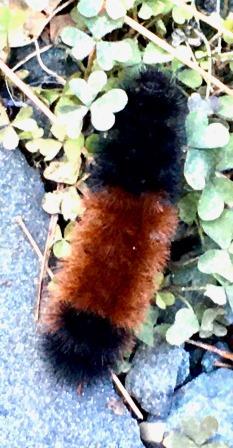
Those moths that circle outdoor lighting in the spring and summer are Isabella tiger moths. They evolved to navigate using the moon as a fixed point. Then humans constructed little electric moons everywhere. The moths were confused, and now circle the light that once guided them. Pretty existential for a moth. They mate, lay eggs and die within a week. Their larva is the wooly worm or bear.
Folklore says that the severity of the coming winter can be predicted by the colors of wooly worms. The more brown, the milder the winter. More black means colder. In fact these colors do not predict the future but recall the past. The milder the previous winter, the earlier these caterpillars are born. The older the caterpillar, the more brown it will display. Several small, mostly mid-western towns have fall festivals where wooly worms undergo careful examination, followed by a prognostication on the coming winter.
Wooly worms are meek, even by caterpillar standards. They roll into a ball when threatened. They are not venomous. They spend the winter completely frozen, most often finding shelter under rocks or dead wood. They are not fussy eaters but do not threaten plants because not enough of them survive to be considered a pest.
Within their meekness, however, there is one brief moment of danger and drama. In the fall, as they seek their winter sanctuaries, they will travel long distances, exposing themselves to footsteps on sidewalks, or birds in meadows. One sees more wooly worms in the open in a few weeks of the fall than all the rest of the year.
This is the great wooly worm challenge. Those that succeed metamorphose to circle summer’s lights, mate and propagate. Do the moths have an appreciation that their earlier selves risked everything for them? That so many did not survive? Does the moth know how lucky it is to have the opportunity to crash again and again into the sconce on my deck? Is dreaming of circling that light what motivated the wooly worm to cross that vast expanse of sidewalk?
Harmless until Threatened
- Details
- Written by PEEC - Janine
- Category: PEEC Blog
A Naif in the Forest by Darrell Berger
Wing Tips to Hiking Boots: Musings of a New, Full-Time Poconos Resident
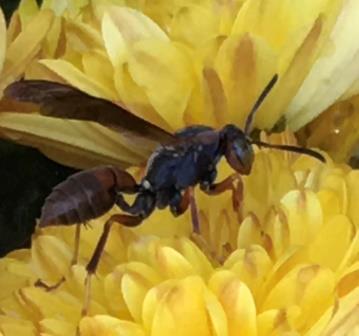
From mid-summer to the end of fall I see many brown paper wasps. In the summer, they join a variety of creatures visiting our flowering plants. They are focused on their job and have no interest in me. My fear of creatures that look like them, motivated by an unpleasant encounter with a hornets’ nest when I was a boy, can stay dormant.
I find them indoors as fall approaches, often near doors, but sometimes having advanced to other rooms. I approach them gingerly but with lethal intent, which turns out to be a needless strategy. Even though they can sting in less than half the time it takes a bee, their venom is stronger than a bee’s. Unlike a bee, hornets can sting repeatedly; the smarter strategy is to leave them alone. They attack only when threatened. The brighter the color, the stronger the sting. Beware the brown paper wasp with red or orange highlights.
As leaves fall, each paper wasp I see appears slower than the last. This is because they are at the end of their lives. Only the hibernating queen will survive the winter. As the season cools, the wasp looks for something warm, like a retiree moving to Florida.
They are beneficial to a habitat, good pollinators and pest controllers. Paper wasps are named for the their papery, gray nests, constructed from dead wood, plant stems, and saliva. Nests can be constructed around many structures, including tree limbs, open pipes, and, a couple years ago, the inside of our outdoor sconce. The nest blocked out the light. There were always dozens of wasps at our door.
I reluctantly protected myself as well as possible and approached them with the necessary lethal spray. Even with their threat level at maximum, I was not attacked by many. Most flew away, now nestless, perhaps to seek warmth and safety indoors, to live out their days in insect exile.
Good for the neighborhood, but dangerous when threatened, seeking a warm place in winter. Even the wasps are not so different from the rest of us here in the forest.
Special Ginkgo Update
- Details
- Written by PEEC - Janine
- Category: PEEC Blog
Naif in the Forest by Darrell Berger
Wing Tips to Hiking Boots: Musings of a New, Full-Time Poconos Resident
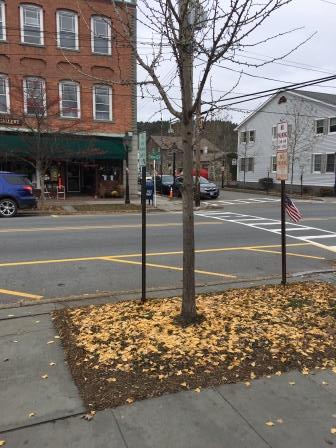
In reference to last week’s entry on the ginkgo tree, here is one in Milford, PA on the corner of Broad and Catherine, in front of the jewelry store. Note that a large pile of leaves is at its base. There are a number of ginkgos along Broad, from this one to the building formerly known as Fretta’s. Many, but not all, have a similar pile of leaves, indicating that most of the leaves fell about the same time.
I also noted that the stems from which the leaves fell look unlike those on any other tree. This shows the ginkgo’s unusual chemistry, which causes all its leaves to fall at once, or nearly so.
I’ve walked by these trees many times without noting or understanding their unique place in the biosphere. There are so many wonders in the world. We ought not to just walk on by.
Until the Last Leaf Falls
- Details
- Written by PEEC - Janine
- Category: PEEC Blog
Naif in the Forest by Darrell Berger
Wing Tips to Hiking Boots: Musings of a New, Full-Time Poconos Resident
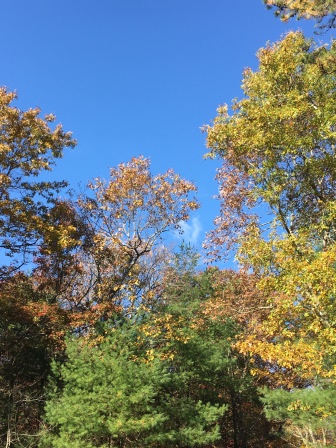
Some people like to judge fall’s colors compared to other years. I love what happens every year: the vivid colors, and also the subtle shades as winter approaches. The only constant is leaves dropping everywhere.
I consider this gradual process a blessing, a final gift from nature before winter. As the final leaves fall I’m ready to fire the wood stove. I’m never ready to shovel snow.
This process is not gradual for all leafy trees. Ginkgo trees lose their leaves all at once, or nearly so, taking an hour or two, usually on one of the first days of heavy frost. They use a unique chemical process to sever the connection with their leaves. Other trees begin with low, smaller branches and end with those nearest the sun.
Ginkgo trees are living fossils that shared the earth with Tyrannosaurus Rex. They have no surviving relatives and, because they repel most animals, have little means of propagation. They are dependent on humans to plant and tend. Long thought extinct in the wild, small groves were recently found in Chinese forests.
Because of their resistance to animals and also urban pollutants, they are often found in cities. They have become a monoculture in some, leading to lack of plant diversity that, in turn, weakens animal and plant diversity.
They grow in most places in North American except the most southern tips. There are a few in Newton Square. I don’t know if they have dropped their leaves this season.
While it is good to know that an ancient life form has survived, I am glad that most trees lose their leaves gradually. Think if all our forest lost all their leaves in a few hours. It would seem like a catastrophe. Our rituals celebrating the change of season from fall to winter would be much different, probably scarier and not for kids. Nature would be viewed as less gentle, more insistent, even cruel.
Seeing such an abrupt change every year might help humanity understand the urgency of responding to changes in nature, and not waiting until the last leaf falls.